 Alfred Ajibola
- 08th October, 2026 @ 02:07 AM
Topics in Chemistry
Chemistry Scheme of Work, SS1 Third Term Chemical Industries: Petrochemicals, Biodegradable, Non-biodegradable Wastes and Pollutants Chemical Industries: Types, Advantages, Disadvantages and Factors affecting Chemical Industries Hydrocarbons: Fractional Distillation of Crude oil and Uses of its Fractions Hydrocarbons: Sources, Classification and Test for Saturated and Unsaturated Hydrocarbons Trioxocarbonates: Preparation, Physical and Chemical Properties, Tests and Uses of Trioxocarbonates Carbon and its Compounds: Oxides of Carbon, Carbon(IV) oxide Carbon and its Compounds: Oxides of Carbon Amorphous Allotropes of Carbon Carbon: Structure and Allotropes of Carbon Salts in Chemistry: Types, Properties, and Uses of Salts Salts in Chemistry, their Classifications, Solubility, Preparations and Colors pH Indicators, Types of Indicators and Importance of pH and pOH Relative Acidity and Alkalinity (pH Scale), and Calculations on pH Bases and Alkalis: Definitions, Classification, Physical and Chemical Properties Bases: Preparation of Bases and Alkalis, Test and Uses Physical and Chemical Properties of Acids, Preparation, Test and Uses of Acids. Acid: Definition, Basicity, and Types of Acid Families of elements in the periodic table Periodic table and Classification of ElementsAcademic Questions in Chemistry
With regards to redox reactions, which of the following statement is wrong?
A. Redox reaction are examples of chemical change
B. Reduction is the gain of electron
C. Substances that donates election during chemical reaction are termed reductants
D. Oxidizing agents are always reduced in chemical reactions
E. Oxidation occurs at the cathode in electrolysis
F. Hydrogen is a reducing agent
In chemistry, physical change is associated only with the rearrangement of molecules while the internal composition of the substance remains the same.
A. True
B. False
_____ electron(s) is a term that describes the number of electron(s) in the outermost shell of an atom.
A. Outer
B. Excess
C. Valence
D. Positive
E. Negative
F. Last
_____ is the negative electrode in electrolysis.
A. Anode
B. Anion
C. Cathode
D. Cation
E. Ion
F. Electrolyte

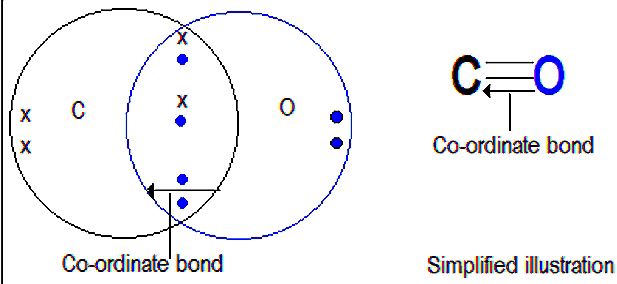
The above diagram shows the _____ type of bond.
A. Covalent
B. Polar covalent
C. Coordinate covalent
D. Metallic
E. Van dear walls
F. Ionic
Metals are referred to as _____ in their impure state.
A. Diluted
B. Consecrated
C. Coloured
D. Ores
E. Stained
F. Strained
Metals generally have the quality to shine, glow, sparkle, glitter, reflect light and be polished. This characteristic of metals is termed _____.
A. State
B. Ductility
C. Luster
D. Malleability
E. Hardness
F. Inflorescence
The _____ spectrometry experiment conducted on isotopic elements gave a confirmation for the existence of isotopes.
A. Mole
B. Volume
C. Weight
D. Number of moles
E. Mass
F. Amount of substance
Carbon forms two important gaseous oxides. These are: carbon monoxide or carbon(II) oxide (CO) and carbon dioxide or carbon(IV) oxide (CO₂). They differ sharply in structure, properties, and toxicity because of the different bonding arrangements between carbon and oxygen.
Structure of CO(g)
Carbon(II) oxide exists as a gas at room temperature. It has a triple bond between carbon and oxygen (C≡O) consisting of two ordinary covalent bonds and one coordinate (or dative) covalent bond.; making it a neutral oxide overall. The lone pair on carbon (coordinate covalent bond) allows CO to act as a ligand toward metal ions (e.g. haemoglobin and transition metals). This bonding is central to its toxicity and its use in some industrial chemistry.
The structure of carbon(II) oxide (CO) is shown below:
You can read on acids, basicity and types of acid here.
Physical properties of CO(g)
Carbon(II) oxide is a colorless, odorless and tasteless gas.
It is slightly less dense than air. This is so because it has a molecular weight of 28.01g/mol, relative to dry air (dry air = 28.96g/mol), and vapor density of 0.97 relative to air (air = 1.0)
It is almost insoluble in water, but dissolves in a solution of ammoniacal copper(I) chloride (also known as ammoniacal cuprous chloride) by forming a soluble addition complex.
It has a melting point of −205°C (−337°F), and boiling point of −191.5°C (−313°F)
It is a neutral oxide (does not turn litmus red or blue, and does not react with acids or bases under normal conditions).
Please read the introduction to carbon, its structure and allotropes here.
Chemical Properties of CO(g)
2CO(g) + O2(g) → 2CO2(g)
CO(g) + CuO(s) → Cu(s) + CO₂(g)
3CO(g) + Fe₂O₃(s) → 2Fe(s) + 3CO₂(g). (Important in the blast furnace)
CO + Hb → COHb
Laboratory preparation of CO(g)
Carbon(II) oxide can be prepared in the laboratory by the dehydration of methanoic (formic) acid using concentrated sulfuric acid (as a dehydrating agent) with gentle heating:
HCOOH(aq) --(conc. H₂SO₄, heat) → CO(g) + H2O(l)
Precaution: This reaction must be done in a fume cupboard because the gas (CO) is poisonous.
Alternatively, it is also prepared by the dehydration of ethanedioic (oxalic) acid with conc. H₂SO₄, giving a mixture of CO and CO₂. The CO₂ can be removed by passing the gas mixture through caustic soda (NaOH) solution, leaving CO.
H2C2O4(aq) --(conc. H₂SO₄) → CO(g) + CO2(g) + H2O(l)
Industrial preparation of CO(g)
Carbon(II) oxide is produced industrially (or in a large-scale) by:
2C(s) + O₂(g) → 2CO(g)
C(s) + H₂O(g) → CO(g) + H₂(g)
2C(s) + O₂(g) + 4N₂(g) [from air] → 2CO(g) + 4N₂(g)
Please read more on the amorphous allotropes of carbon (coal and coke) here.
Main confirmatory test for CO(g)
Carbon(II) oxide burns with a blue flame, producing CO2 gas in the process. This gas produced (when passed into limewater) turns limewater milky, (which confirms the burning product is CO₂, indirectly confirming the original gas was CO).
2CO(g) + O2(g) → 2CO2(g).
The CO2 gas turns limewater -Ca(OH)2 milky.
Note: CO does not turn limewater milky. (This distinguishes it from CO₂).
Other test for CO(g) in the Lab.
CO can also be identified by passing it over heated palladium(II) chloride solution. It turns the solution black through the deposits a black precipitate of palladium metal. (This is a specific lab test).
Note: The method of burning of CO in air with the product passed through imewater remains the standard test expected at this level.
Please read on pH indicators, types and importance of pH and pOH
Carbon(II) oxide (CO) is introduced into the atmosphere through the following:
Incomplete combustion of fuels (petrol/diesel engines, especially with insufficient air supply).
Exhaust fumes from motor vehicles.
Incomplete combustion in industrial processes and poorly ventilated fires/stoves.
Cigarette smoke.
Use of generators in closed environments.
Some natural processes (e.g. volcanic activity and forest fires) in small amounts.
Carbon(II) oxide (CO) is removed from the atmosphere through the following:
Oxidation in the atmosphere (where it slowly reacts with oxygen/atmospheric radicals over time) to form CO₂.
Uptake and conversion by certain soil microorganisms.
Natural atmospheric mixing/dilution and gradual chemical breakdown.
Note: Carbon(II) oxide does not have a large or well-defined "natural cycle" as carbon(IV) oxide (CO₂). In this regard, iit is mainly regarded as a pollutant that is slowly oxidized away.)
You can read a brief note on dynamic equilibrium in chemistry here.
Carbon(II) oxide (CO) is highly poisonous, even in small concentrations, and is especially dangerous because it is colorless and odorless (cannot be detected by human senses).
Mechanism of toxicity
Carbon(II) oxide (CO) binds to haemoglobin in red blood cells far more strongly than oxygen does (forming carboxyhaemoglobin), with an affinity roughly 200+ times greater than that of oxygen. This prevents haemoglobin from carrying oxygen around the body, starving tissues and organs (especially the brain and heart) of oxygen. This condition is called hypoxia.
Since the binding is very strong and only slowly reversible, even relatively low concentrations of CO over time can cause serious harm.
The symptoms of CO poisoning include headache, dizziness, nausea, confusion, weakness. At higher exposure, CO poisoning leads to loss of consciousness and death.
Sources of CO danger: include the following:
Faulty gas heaters/boilers
Blocked chimneys/flues
Car engines running in enclosed spaces (e.g. closed garages)
charcoal stoves used indoors without ventilation.
Generators used indoors without ventilation.
Please read on the adverse effects of chemistry here.
Carbon(II) oxide is used as a fuel (component of water gas and producer gas), applied in heating; and in various industries.
As a reducing agent, it is used in metallurgy, especially in the extraction of iron in the blast furnace.
It is used in the manufacture of certain chemicals, e.g. in some industrial synthesis routes (such as production of methanol) as a source of carbon.
It can react with transition metals (like nickel or iron) to form metal carbonyls. These metal carbonyls are used in refining high-purity metals.
It serves as a reagent in carbonylation reactions to produce organic compounds such as aldehydes, carboxylic acids, and polymers.
Please read on the uses of chemistry here.
| Property | CO | CO₂ |
| Bonding | Triple bond (C≡O) | Double bonds (O=C=O), linear |
| Nature of oxide | Neutral oxide | Acidic oxide |
| Color/odor | Colorless, odorless | Colorless, odorless |
| Density vs air | Slightly less dense | About 1.5× denser |
| Solubility in water | Almost insoluble | Fairly soluble (forms weak acid) |
| Combustion | Burns with blue flame | Does not burn/support combustion |
| Test | Burns blue; product turns limewater milky | Turns limewater milky, then clear in excess |
| Main hazard | Highly toxic. Binds haemoglobin, causes hypoxia / Asphyxiant | Displaces oxygen, not directly poisonous |
| Key source | Incomplete combustion | Respiration, complete combustion, decay and volcanic activity |
| Key removal process | Slow atmospheric oxidation to CO₂ | Photosynthesis, dissolving in oceans, carbonate rock formation |
Please read on the next topic (Oxides of carbon: carbon(IV) oxide) here.
Kindly share this article via the links below:
Please click here to contact Alfred if you require any of the following services:
If you need a standard website at an affordable price.
Online training on the academic subjects: biology, chemistry and basic science.
If you require an advanced smart school management system (web application) for your school.
Click here to read on Len Academy Smart School Software.
Please click here to follow Len Academy on Google News.
Amazing facts in Chemistry
Plastic and Glass can decompose, but not in our lifetimes. It takes an average time of 450 years for plastics to decompose. As for the decomposition of glasses, it takes about 4,000 years
The only letters that failed to appear on the periodic table are letters:
Gold and copper are the only two non-silvery colored metals.
Copper is the only metal that is naturally antibacterial. For this reason, some children utilize 'copper water bottles' in schools
Water freezes faster when it’s warm than when it’s cold
Most element in their pure state exists physically in different forms. For instance, pure carbon can exist as both diamond and graphite. This phenomenon is called allotropy
If you pour a handful of salt into a full glass of water, the water level will go down rather than overflowing the glass.
Similarly, if you mix half liter of water and half litre of alcohol, the total volume of the liquid will be les than one litre
Notable points in Chemistry
Below are the physical properties of metals:
They exist in solid state.
The have high densities.
They are good conductors of heat and electricity.
The have the ability to be polished, to glow, sparkle and reflect light.
They can be bent, flattened and made into sheets called foils.
They can be drawn into wires.
Iron undergoes magnetism while most metals are poorly magnetized.
They typical have high melting point.
They generally have high boiling point.
With the exception of lithium, sodium and potassium, most metals are generally hard.
They have the ability to make sound when in contact with other objects or metals.
Please read details on the physical properties of metals here
John Dalton is an English chemist who brought clarity into the composition of matter and the basis for their chemical reactions.
Below are Dalton's Atomic Theory:
All matter consists of tiny indivisible particles called atoms.
Atoms of the same element are identical to each other in every aspect because they have the same shape and mass, while atoms of different elements are different in all respect.
Atoms are indestructible and can neither be created nor destroyed.
Atoms of different elements can combine with each other in simple whole number ratios to form compounds.
Atoms of the same element share similar physical and chemical properties. They can also combine in more than one ratio to form two or more compounds.
Meanwhile, understand that the above theories of John Dalton had been modified.
Please read on Dalton's atomic theory and its modifications here

The periodic table, also called periodic table of elements or Mendeleev's table, is a table that shows an organized arrangement of the 118 chemical elements according to their atomic number.
Out of the 118 elements; elements 1 - 94 are present in nature while elements 95 - 118 are synthesized artificially.
The manner at which elements are arranged on this table reveals some similarities in their electronic configurations and chemical properties.
A compound composed of iron (Fe) and oxygen (O) was analyzed and found to contain 69.94% iron and 30.06% oxygen. Find the empirical formula of the compound. (Molar mass of Fe=55.85, O=16)
Step 1: Identify the given parameter from the question.
Fe = 69.94%, O = 30.06%.
Empirical formula = Fe?O?
Step 2: Convert the percentages to gram. (just attribute grams to the %).
Step 3: To get the mole ratio of each element, convert the gram to moles using the formula (mole = mass/molarmass). Please merorize this formula because we always work with moles in emperical formula.
Mole of Fe: 69.94/55.85 = 1.252mol
Mole of O: 30.06/16 = 1.879mol
Step 4: Divide both sides by the smallest mole ratio.
Iron has the smallest mole ratio in our case, therefore: 1.252/1.252 = 1, 1.879/1.252 = 1.5
We now have the formula = Fe1O1.5
Step 5: Multiply each of the moles by the smallest whole number that will convert each into a whole number. (In our case, the number '2' is the smallest whole number that will make '1.5' and '1' whole numbers when multiplied by it.
For iron (Fe), we will have 1 x 2 = 2
For oxygen (O), we will have 1.5 x 2 = 3
Step 6: Write the empirical formula.
The empirical formula= Fe2O3
Iron(III)tetraoxosulphate(VI)
In chemistry, hydrocarbons can be classified as either aliphatic or aromatic. Recently, both classifications of hydrocarbon were based on their structure rather than their origin.
Aliphatic hydrocarbons are put into three main groups according to the types of bonds they possess. These are:
Alkanes
Alkenes
Alkynes
They are shown in the image below:

It's important to note the followings:
Alkanes have single bonds (only) in their structures.
Alkenes always have a carbon-carbon double bond present in their structure.
Alkynes always have a carbon-carbon triple bond present in their structure.
Aromatic hydrocarbons are classified into:
