Topics in Economics
Forms of Socialism in Government Advantages and Disadvantages of Capitalism What is Capitalism? Characteristics of Capitalism Types of price elasticity of demand Types of elasticity of demand Types of capital market: Primary market and secondary market Capital market explained with its functions Basic tools for economic analysis: Graphs explained with its characteristics and importance Basic tools for economic analysis: Tables explained with its characteristics and importance Factors affecting population in economics Advantages of Inflation Disadvantages of Inflation Concept of Inflation in Economics Scheme of work for Economics, SS1, First Term Scheme of work for Economics, SS1, Second Term Scheme of Work for Economics, SS1, Third Term Functions of the Wholesaler Advantages and Disadvantages of the Wholesaler Wholesale Market: Who is a Wholesaler? Characteristics of the WholesalerAcademic Questions in Economics
_____ is defined as a gradual and sustained rise in price level of goods and services in relation to their availability.
A. Basis Point Rate
B. Hike Rate
C. Elastic Supply
D. Elasticity of Price
E. Price Inflation
F. Aggregate Supply
The wholesalers can bring about an economy of scale.
A. True
B. False
Which of the following statement isn't a characteristics of the wholesaler?
A. They may have to operate in specific areas or regions accorded them by the producer
B. They are often popular in the line of goods they supply
C. They are not risk bearers
D. They have good storage facilities
E. They often pay for goods supplied by the manufacturers in advance
F. They usually have business agents or brokers
The wholesalers act as the middlemen in supply chain.
A. True
B. False
Large retailers who buy directly from manufacturers are termed as _____.
A. Wholesale Retailers
B. Certified Retailers
C. Codified Retailers
D. Commodity Retailers
E. Manufacturers Retailer
F. Conspicuous Retailers
_____ is a market whereby the sellers buy goods in lesser quantities from the wholesalers and sells in bits to the final consumers.
A. Commodity
B. Retail
C. Wholesale
D. Labour
E. Common
F. General
Which of the following is not a financial market?
A. Money Market
B. Bond Market
C. Foreign Exchange Market
D. Virtual Market
E. Capital Market
F. Stock Exchange Market
A _____ market provides a platform whereby job seekers link up with employers in an attempt to be hired.
A. Wholesale market
B. Bond market
C. Physical market
D. Virtual market
E. Factor Market
F. Labor Market
Price elasticity of demand is a fundamental concept in economics that measures how sensitive the quantity demanded of a good or service is to a change in its price. For students pursuing economics or related fields, grasping this concept is essential as it influences everything from business pricing strategies to government policies.
Below is a breakdown of the different types of price elasticity of demand that every student should understand.
Please read on the types of elasticity of supply here.
When the demand for a product is considered price elastic, it means that a small change in price results in a significant change in the quantity demanded. In this case, the price elasticity of demand (PED) coefficient is greater than one: (PED > 1).
Ed > 1
Where Ed = Elasticity of demand
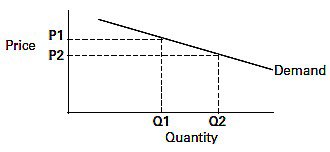
The above graph shows an elastic price demand.
You can read on charts and graphs as basic tools of economic analysis.
Price Elastic Demand typically applies to luxury goods or non-essential items; for instance, a high-end smartphone. If the price of such a smartphone increases, consumers may opt not to purchase it, and perhaps choose a cheaper alternative (which can serve similar function), leading to a substantial drop in the quantity demanded.
Conversely, when demand is price inelastic, consumers are less sensitive to changes in price. This means that a price change will result in a relatively small change in the quantity demanded. In this regard, The price elasticity of demand (PED) coefficient is less than one: (PED < 1).
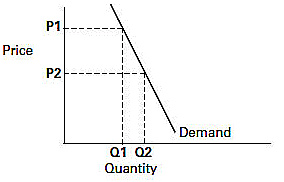
Ed < 1
Essential products such as medications or basic utilities tend to have inelastic demand. Even if the price rises, consumers will still purchase them since they are necessities.
Please read on the concept of inflation in economics here.
Unitary elastic demand occurs when a change in price results in an equal percentage change in the quantity demanded. In other words, the PED coefficient equals one (PED = 1).
Ed = 1
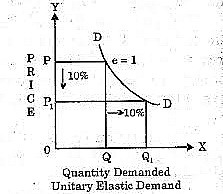
The situation where Unitary Elastic Demand occurs are rare, and thus often theoretical, but can be observed in certain market conditions or during specific transaction periods.
For instance, if the price of a concert ticket increases by 10%, and the quantity demanded also decrease by 10%; then the demand for the concert ticket with regards to the change in price is considered to be unitary elastic.
Please read on demand schedule and its types here.
Perfectly elastic demand is seen in a special case where consumers are extremely sensitive to price changes. This means that at a specific price, the quantity demanded can drop to zero even if the price increases just slightly.
On the contrary, the demand for a product can increase infinitely if the price is reduced, even slightly. For this reason, the change that accompanies a perfectly elastic demand is considered to be infinite.
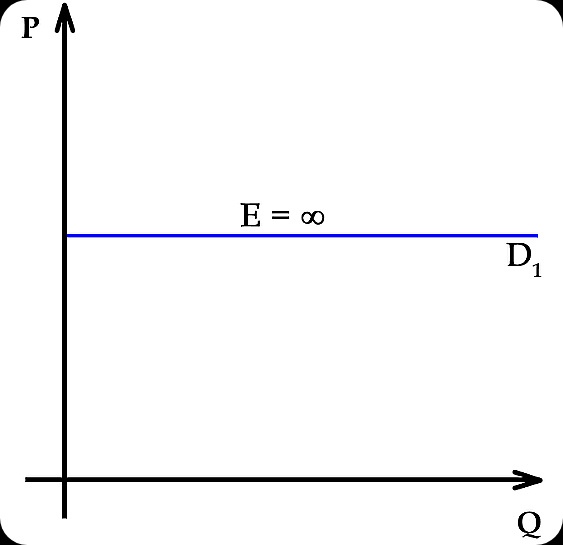
Ed = ♾️
Please read on the graphical representation of supply curve here.
Graphically, this is represented as a horizontal line. Perfectly elastic demand is often seen in highly competitive markets, where consumers can easily switch to substitute products whenever prices rise.
At the other extreme is perfectly inelastic demand, where the quantity demanded remains constant regardless of price changes.
The situation triggering a perfectly inelastic demand typically applies to essential commodities with no close substitutes, such as life-saving medications. Therefore, no matter the cost of the product (specific drugs in this instance), consumers will always purchase the same amount, leading to a vertical demand curve.
Ed = 0
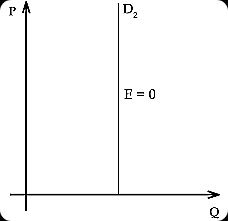
Since there isn't any change in the quantity of goods (or services) demanded, perfectly inelastic demand will always be zero, and is thus termed as zero elasticity of demand.
You can read on income and cross elasticity of demand here..
Understanding the various types of price elasticity of demand provides students with valuable insights into consumer behavior and market dynamics. By recognizing how different goods respond to price changes, students can better appreciate the intricacies of economic theory and its real-world applications.
Whether considering business strategies or government policies, the concept of price elasticity remains a critical tool for analyzing economic scenarios.
As you continue your studies, consider how these different elasticities might influence market behaviors and decision-making processes.
Kindly share this article via the links below:

Please click here to contact Alfred if you require any of the following services:
If you need a standard website at an affordable price.
Online training on the academic subjects: biology, chemistry and basic science.
If you require an advanced smart school management system (web application) for your school.
Click here to read on Len Academy Smart School Software.
Please click here to follow Len Academy on Google News.
Amazing facts in Economics
Notable points in Economics
A unitary elasticity of supply is seen when a change in price brings about a corresponding and proportional change in the quantity of goods or services supplied.
The graph below shows a unit elasticity of supply:

Below is an instance of a unitary elasticity of supply:
If a 100% increase in the price of wheat translates into a 100% increase in the production and supply of wheat, then the supply elasticity is said to be unitary elastic and its value is equal to 1.
Unitary elasticity is always equal to 1, that is: Es = 1
The supply curve runs diagonally and will pass through the center.
Supply elasticity is defined as the rate at which an increase in price of goods translates into its increased production and availability in the market. Supply elasticity is also termed as price elasticity of supply.
Consider the statements below:
If a 100% increase in the price of rice translates into a 100% increase in the production and supply of rice, the supply elasticity is said to be unitary elastic and its value is equal to 1.
If a 100% increase in the price of rice translates into a 50% increase in the production and supply (quantity) of rice, the supply elasticity is said to be inelastic and its value will be greater than zero and less than 1. In this case, the exact value is 0.5: (value of change in the quantity of rice divided by value of change in price of rice = 50/100 = 0.5).
The individual demand schedule is a table that shows the demand of a commodity that an individual (consumer) purchased at various prices, and at a particular time.
The table below shows an individual demand schedule:
|
Price in Naira (of a tuber of yam) |
Quantity demanded (per week) |
|
500 |
5 |
|
400 |
10 |
|
300 |
15 |
|
200 |
20 |
|
100 |
25 |
The market demand schedule is also referred to as an aggregate demand schedule, total demand schedule or composite demand schedule.
This is a table that shows the different commodities purchased by all the consumers or customers in the market.
The market demand schedule is the summation of the individual demand schedules, showing the demand of different customers for a commodity at a particular price. It is shown in the table below:
|
Unit price of commodity (Naira) |
Quantity demanded by consumer A (QA) |
Quantity demanded by consumer A (QB) |
Market demand (QA + QB) |
|
50 |
20 |
15 |
35 |
|
40 |
40 |
30 |
70 |
|
30 |
60 |
45 |
105 |
|
20 |
80 |
60 |
140 |
|
10 |
100 |
75 |
175 |
From the above table, notice that when the unit price of the commodity was 50 Naira, consumer A demanded 20 quantities while consumer B demanded 15 quantities.
Below are definitions of demand from the perspective of some notable professors:
The demand for goods is a schedule of the amounts that buyers would be willing to purchase at all possible prices at any one instant of a time.
Professor Mayers
Demand is the various quantities of goods that would be purchased per time period at different prices in a given market.
Professor Hibdon
The demand for anything, at a given price is the amount of it which will be bought per unit of time at the price.
Professor Benham
Generally, demand is defined as the willingness of a person, buyer or consumer to buy a specific quantity of goods or service at a given price and time.
From the above definitions, we can infer that the definition of demand is referenced to three major factors. These are:
Quantity of Goods Demanded
Price
Time