 Alfred Ajibola
- 05th October, 2026 @ 04:13 PM
Topics in Chemistry
Chemistry Scheme of Work, SS1 Third Term Chemical Industries: Petrochemicals, Biodegradable, Non-biodegradable Wastes and Pollutants Chemical Industries: Types, Advantages, Disadvantages and Factors affecting Chemical Industries Hydrocarbons: Fractional Distillation of Crude oil and Uses of its Fractions Hydrocarbons: Sources, Classification and Test for Saturated and Unsaturated Hydrocarbons Trioxocarbonates: Preparation, Physical and Chemical Properties, Tests and Uses of Trioxocarbonates Carbon and its Compounds: Oxides of Carbon, Carbon(IV) oxide Carbon and its Compounds: Oxides of Carbon Amorphous Allotropes of Carbon Carbon: Structure and Allotropes of Carbon Salts in Chemistry: Types, Properties, and Uses of Salts Salts in Chemistry, their Classifications, Solubility, Preparations and Colors pH Indicators, Types of Indicators and Importance of pH and pOH Relative Acidity and Alkalinity (pH Scale), and Calculations on pH Bases and Alkalis: Definitions, Classification, Physical and Chemical Properties Bases: Preparation of Bases and Alkalis, Test and Uses Physical and Chemical Properties of Acids, Preparation, Test and Uses of Acids. Acid: Definition, Basicity, and Types of Acid Families of elements in the periodic table Periodic table and Classification of ElementsAcademic Questions in Chemistry
With regards to redox reactions, which of the following statement is wrong?
A. Redox reaction are examples of chemical change
B. Reduction is the gain of electron
C. Substances that donates election during chemical reaction are termed reductants
D. Oxidizing agents are always reduced in chemical reactions
E. Oxidation occurs at the cathode in electrolysis
F. Hydrogen is a reducing agent
In chemistry, physical change is associated only with the rearrangement of molecules while the internal composition of the substance remains the same.
A. True
B. False
_____ electron(s) is a term that describes the number of electron(s) in the outermost shell of an atom.
A. Outer
B. Excess
C. Valence
D. Positive
E. Negative
F. Last
_____ is the negative electrode in electrolysis.
A. Anode
B. Anion
C. Cathode
D. Cation
E. Ion
F. Electrolyte

The above diagram shows the _____ type of bond.
A. Covalent
B. Polar covalent
C. Coordinate covalent
D. Metallic
E. Van dear walls
F. Ionic
Metals are referred to as _____ in their impure state.
A. Diluted
B. Consecrated
C. Coloured
D. Ores
E. Stained
F. Strained
Metals generally have the quality to shine, glow, sparkle, glitter, reflect light and be polished. This characteristic of metals is termed _____.
A. State
B. Ductility
C. Luster
D. Malleability
E. Hardness
F. Inflorescence
The _____ spectrometry experiment conducted on isotopic elements gave a confirmation for the existence of isotopes.
A. Mole
B. Volume
C. Weight
D. Number of moles
E. Mass
F. Amount of substance
Carbon is a the first member of group IV elements (or group 14 in modern IUPAC numbering) and the fourth element in period 2 of the periodic table. It has the chemical symbol "C", with an atomic number - 6, and atomic (or mass number) - 12.
Carbon has the electronic configuration →1s² 2s² 2p², which can be simply written simply as "2, 4". The 2, 4 electronic configuration of carbon implies that it has 2 electrons in the first shell (K-shell) and 4 electrons in the outer (valence) shell (L-shell).
Note: The electronic configuration of elements is significant (important) in chemistry because it helps us understand the behavior and properties of each (respective) element.
Please read on families of elements in the periodic table here.
Carbon has 4 valence electrons, making it tetravalent. As a consequence, it forms 4 covalent bonds.
Being in Group IV, it is equidistant from achieving a noble gas configuration by either losing or gaining (4) electrons, so it almost always forms covalent bonds by sharing electrons (rather than by accepting or giving out 4 electrons through electrovalent (ionic) bonding).
Carbon atoms can bond to one another repeatedly to form long chains and rings. This property of carbon is called catenation. For this reason, carbon forms millions of compounds (as studied in organic chemistry) and several structural forms of the element itself (allotropes).
You can read a brief introduction to organic chemistry here.
Allotropy is defined the existence of an element in two or more different physical forms in the same physical state, with the different forms (allotropes) having different physical properties but the same chemical properties.
Carbon exists as allotropes. These are grouped into:
Crystalline allptropes: The carbon atoms are arranged in a definite, orderly, repeating pattern (lattice): Examples of crystalline allptropes of carbon include diamond, graphite, fullerenes and graphene.
Amorphous allptropes: Carbon atoms are not arranged in a regular lattice: Examples of amorphous carbon allptropes include coal, coke, charcoal, soot (lamp black), and animal charcoal.
Please read on detail the amorphous allotropes of carbon here
Structure of Diamond
Diamond is a crystalline allotrope of carbon with each carbon atom bonded covalently to 4 other carbon atoms arranged tetrahedrally (bond angle 109.5°). This forms a rigid, three-dimensional (3D) giant covalent (macromolecular) crystal lattice structure (known as the diamond cubic crystal system) extending throughout the crystal.
Each carbon atom making up the diamond molecule is sp3 hybridized and covalently bonded to four other carbon atoms pointing toward the corners of a regular tetrahedron.
The molecular structure of diamond is represented via the image below.
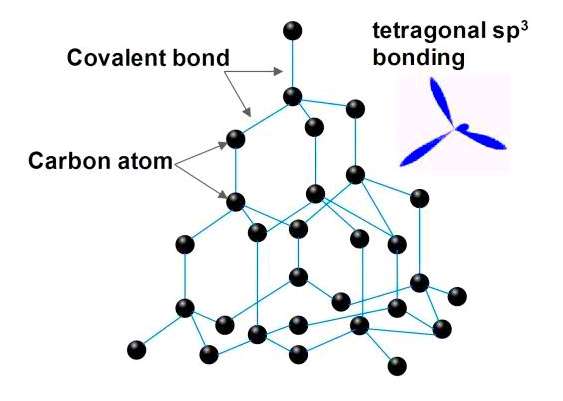
Note: All bonds are strong single covalent bonds of equal length.
You can read on salts in chemistry, their classification, solubility, preparations and colors here.
Diamond is extremely hard. In fact, it is the hardest known natural substance on earth. Diamond is very hard because of its rigid 3D network of strong covalent bonds. It's hardness rates a 10 on the Mohs scale (which is the maximum rating on this scale for measuring mineral hardness).
It has a high melting point (~3550 °C). In this regard, a lot of energy is needed to break the many strong covalent bonds.
Diamond does not conduct electricity. This is so because all 4 valence electrons of each carbon atom are used in bonding; and as a result, there are no free, delocalized or mobile electrons.
Diamond has a high thermal conductivity. In fact, it conducts heat better than any other material, even silver.
It is insoluble in water and organic solvents.
It has a high density and high refractive index. This is the reason for its brilliance when cut. It also bends light sharply to create colorful flashes of fire and brilliance. The image below shows this:
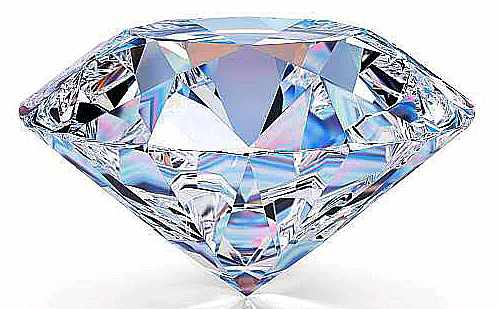
Diamond is made entirely of carbon atoms linked in a rigid 3D covalent crystal structure
You can read on the physical and chemical properties of acids, test and uses of acids here.
Diamond is used as cutting, drilling, and grinding tools (e.g glass cutters, drill bits, diamond saws).
It is used in the production of jewellery (gemstones).
It is used in polishing hard materials, gems, and carbide tools.
Diamondsm is used in the manufacture of surgical blades (like scalpel knives) which provide ultra-fine, precise edges used in delicate procedures like eye surgery (e.g, cataract removal).
They have the highest thermal conductivity of any natural material, making them ideal for drawing heat away from microprocessors and lasers.
Nanodiamonds (tiny diamond particles) can help track and transport cancer-fighting drugs inside human cells.
Windows made of diamond can protect vacuum chambers and high-power laser windows from intense heat and pressure.
You can read on pH indicators, types and importance of pH and pOH here.
Structure of graphite
Graphite is a crystalline allotrope of carbon with each carbon atom bonded covalently to 3 other carbon atoms in the same plane, forming hexagonal rings. These hexagons join to form flat layers (or sheets).
Note: The 4th electron of each carbon atom is not used in bonding within the layer, making it it delocalized (free and mobile); and moves between the layers. This is shown below:
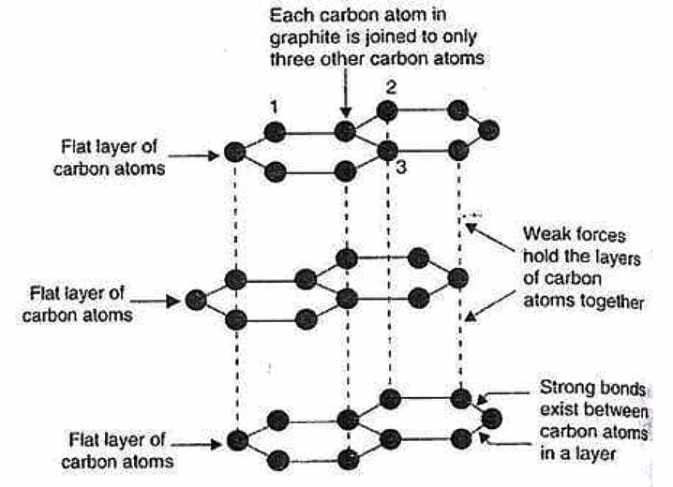
The layers are held together by weak Van Der Waals forces, allowing them to slide over one another.
You can read on bases and alkalis, their preparation, test and uses here.
Graphite has a greyish-black, opaque appearance with a metallic lustre.
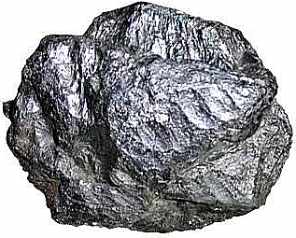
Graphite is a good conductor of heat and electricity due to the delocalized (free) electrons that can move along the layers.
Graphite has a high melting point (~3600–3700 °C), and it sublimes (turns directly from a solid into a gas without turning into a liquid first). Meanwhile, understand that the covalent bonds within each layer are strong, giving rise to its high melting point.
The layers of graphite are slippery, and slide over each other easily because of the weak forces between them.
Graphite is lighter (less dense) than diamond.
It remains stable at low temperatures, but in the presence of oxygen at high temperatures (above 700 °C), it oxidizes to form carbon dioxide. (This is a chemical property of graphite).
It resists attack from most acids, alkalis, and organic solvents under normal conditions.
Please read on bases and alkali, their classification, physical and chemical properties here.
It is used as lead in pencils (when mixed with clay). Simply put, it is mixed with clay to make the dark marks in pencils.
Fine graphite powder is used as a dry lubricant for machine parts to stops squeaks and lubricates locks without catching dirt. It is useful where oil would attract dust.
It is used as electrodes in electrolysis and dry cells (because it conducts electricity and resists heat). Please read ionic theory and electrolysis here.
Graphite is a key material used in the anodes (negative side) of lithium-ion batteries.
It is used in the manufacture of crucibles for melting metals (because it withstands high temperatures).
It is used in steelmaking where it adds carbon to steel and lines high-heat furnaces since it can withstand extreme temperatures.
Graphite fibres mixed with plastic helps to build strong, and light tennis rackets, and golf clubs.
Since it conducts electricity and heat well, it is used in cooling parts and electrical brushes.
The table below shows the differences between diamond and graphite:
| Feature | Diamond | Graphite |
| Structure | 3D tetrahedral network | 2D hexagonal layers |
| Bonds per Carbon | 4 covalent bonds | 3 covalent bonds |
| Appearance | Clear and transparent | Greyish-black and opaque |
| Hardness (Mohs) | 10 (hardest known natural substance) | 1–2 (soft and greasy) |
| Electrical Conductivity | Insulator (non-conductor) | Conductor (due to free electrons) |
| Density | ~ 3.5 g/cm³ | 2.2–2.3 g/cm³ |
| Hybridisation | sp³ | sp² |
| Interlayer Forces | None (rigid 3D frame) | Weak van der Waals forces |
| Common Uses | Jewelry and cutting tools | Pencils and lubricants |
You can read on the differences between physical and chemical changes in chemistry here.
Fullerene (C₆₀) was discovered more recently (in 1985) by the scientists: Harold Kroto, Richard Smalley, and Robert Curl . They won the Nobel Prize in Chemistry for their discovery in 1996.
The molecules of fullerenes such as buckminsterfullerene or buckyball (C₆₀) consists of carbon atoms arranged in closed hollow cage-like structures (spheres, ellipsoids, or tubes).
A fullerene is an allotrope of carbon whose molecules consist of carbon atoms connected in closed cages, tubes, or ellipsoids.
Structure of Fullerenes
Fullerene is made entirely of carbon atoms joined by single and double bonds. The carbon atoms form fused 5-membered (pentagonal) and 6-membered (hexagonal) rings. The pentagon rings force the structure to curve into a closed cage. Below is an image of fullerene C60.
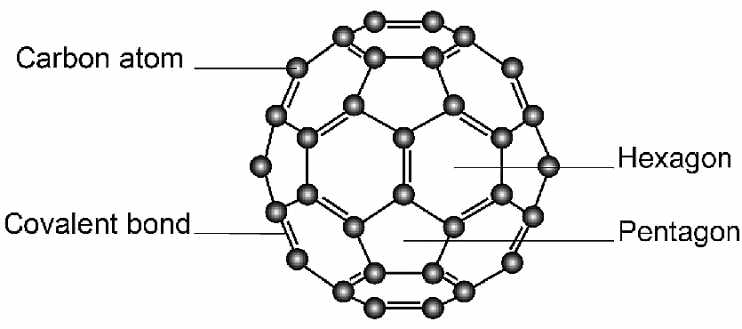
The shapes of common forms of fullerenes include spherical buckyballs C60 and cylindrical carbon nanotubes.
Note: Each carbon atom in fullerene is sp2 hybridized and bonded to three other atoms.
Types of Fullerene
Buckminsterfullerene (C60)
Higher Fullerenes (C70, C76, C78 and C84).
Carbon Nanotubes (CNTs)
Heterofullerenes
Endohedral Fullerenes
Fullerenols
Megatubes
You can read on the uses of chemistry here.
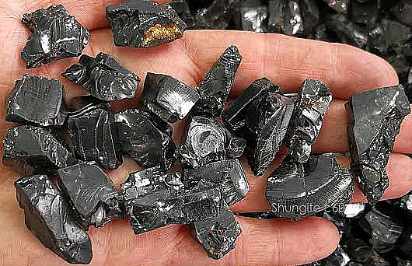
They are dark-colored crystalline solids or powders at room temperature. The buckminsterfullerene C60 is a blackish-brown solid.
Buckminsterfullerene (C60) is composed of fused pentagonal and hexagonal carbon rings. The carbon atoms arranged in 12 pentagons and 20 hexagons, looking like a football.
Compared to diamond and graphite, they have a relatively low density (around 1.65g/cm3) for C60.
They have hollow interior and can trap other atoms or small molecules inside (endohedral fullerenes).
They can withstand high pressures and return to their original shape.In this regard, they are highly compressible, have high tensile strength, can withstand high pressures, returning to their original shape. They are resistance to deformation.
Fullerenes can behave as semiconductors (of heat and electricity) when mixed (doped) with alkaline earth metals like potassium and cesium.
They are hydrophobic and completely insoluble in water. However, they are soluble in specific organic solvents like carbon disulfide, toluene and benzene.
Although, individual molecules of fullerene are hard, a bulk solid fullerene can act as a soft, slippery lubricant (which acts like microscopic ball bearings).
Pure fullerenes are poor conductor of heat and electricity.
They have high electron affinity. This implies that they can easily accept electrons.
You can attempt various questions in chemistry here.
They are used in medicine as targeted drug delivery, research and as antioxidants or antiviral agents.
They are needed in nanotechnology. In this regard, they are applied in electronics, sensors, and solar cells.
They are utilized in water purification systems to trap pollutants.
They can be used as lubricants.
Please read the continuation of this topic on (amorphous allotropes of carbon) here.
Kindly share this article via the links below:
Please click here to contact Alfred if you require any of the following services:
If you need a standard website at an affordable price.
Online training on the academic subjects: biology, chemistry and basic science.
If you require an advanced smart school management system (web application) for your school.
Click here to read on Len Academy Smart School Software.
Please click here to follow Len Academy on Google News.
Amazing facts in Chemistry
Plastic and Glass can decompose, but not in our lifetimes. It takes an average time of 450 years for plastics to decompose. As for the decomposition of glasses, it takes about 4,000 years
The only letters that failed to appear on the periodic table are letters:
Gold and copper are the only two non-silvery colored metals.
Copper is the only metal that is naturally antibacterial. For this reason, some children utilize 'copper water bottles' in schools
Water freezes faster when it’s warm than when it’s cold
Most element in their pure state exists physically in different forms. For instance, pure carbon can exist as both diamond and graphite. This phenomenon is called allotropy
If you pour a handful of salt into a full glass of water, the water level will go down rather than overflowing the glass.
Similarly, if you mix half liter of water and half litre of alcohol, the total volume of the liquid will be les than one litre
Notable points in Chemistry
Below are the physical properties of metals:
They exist in solid state.
The have high densities.
They are good conductors of heat and electricity.
The have the ability to be polished, to glow, sparkle and reflect light.
They can be bent, flattened and made into sheets called foils.
They can be drawn into wires.
Iron undergoes magnetism while most metals are poorly magnetized.
They typical have high melting point.
They generally have high boiling point.
With the exception of lithium, sodium and potassium, most metals are generally hard.
They have the ability to make sound when in contact with other objects or metals.
Please read details on the physical properties of metals here
John Dalton is an English chemist who brought clarity into the composition of matter and the basis for their chemical reactions.
Below are Dalton's Atomic Theory:
All matter consists of tiny indivisible particles called atoms.
Atoms of the same element are identical to each other in every aspect because they have the same shape and mass, while atoms of different elements are different in all respect.
Atoms are indestructible and can neither be created nor destroyed.
Atoms of different elements can combine with each other in simple whole number ratios to form compounds.
Atoms of the same element share similar physical and chemical properties. They can also combine in more than one ratio to form two or more compounds.
Meanwhile, understand that the above theories of John Dalton had been modified.
Please read on Dalton's atomic theory and its modifications here

The periodic table, also called periodic table of elements or Mendeleev's table, is a table that shows an organized arrangement of the 118 chemical elements according to their atomic number.
Out of the 118 elements; elements 1 - 94 are present in nature while elements 95 - 118 are synthesized artificially.
The manner at which elements are arranged on this table reveals some similarities in their electronic configurations and chemical properties.
A compound composed of iron (Fe) and oxygen (O) was analyzed and found to contain 69.94% iron and 30.06% oxygen. Find the empirical formula of the compound. (Molar mass of Fe=55.85, O=16)
Step 1: Identify the given parameter from the question.
Fe = 69.94%, O = 30.06%.
Empirical formula = Fe?O?
Step 2: Convert the percentages to gram. (just attribute grams to the %).
Step 3: To get the mole ratio of each element, convert the gram to moles using the formula (mole = mass/molarmass). Please merorize this formula because we always work with moles in emperical formula.
Mole of Fe: 69.94/55.85 = 1.252mol
Mole of O: 30.06/16 = 1.879mol
Step 4: Divide both sides by the smallest mole ratio.
Iron has the smallest mole ratio in our case, therefore: 1.252/1.252 = 1, 1.879/1.252 = 1.5
We now have the formula = Fe1O1.5
Step 5: Multiply each of the moles by the smallest whole number that will convert each into a whole number. (In our case, the number '2' is the smallest whole number that will make '1.5' and '1' whole numbers when multiplied by it.
For iron (Fe), we will have 1 x 2 = 2
For oxygen (O), we will have 1.5 x 2 = 3
Step 6: Write the empirical formula.
The empirical formula= Fe2O3
Iron(III)tetraoxosulphate(VI)
In chemistry, hydrocarbons can be classified as either aliphatic or aromatic. Recently, both classifications of hydrocarbon were based on their structure rather than their origin.
Aliphatic hydrocarbons are put into three main groups according to the types of bonds they possess. These are:
Alkanes
Alkenes
Alkynes
They are shown in the image below:

It's important to note the followings:
Alkanes have single bonds (only) in their structures.
Alkenes always have a carbon-carbon double bond present in their structure.
Alkynes always have a carbon-carbon triple bond present in their structure.
Aromatic hydrocarbons are classified into:
