Topics in Biology
Terms in Heredity and Genetics explained Heredity and Genetics in Biology Stages of Ecological Succession explained with their Characteristics Ecological Succession: Types of Ecological Succession Botanical classification of plants Characteristics of dicots Characteristics of monocots Differences between lions and tigers Cellular respiration in biology Len Academy biology mock questions for waec Len Academy biology midterm questions for SS1, 2nd Term Characteristics of saltwater habitat Aquatic habitat explained with its types Types of habitat: Terrestrial habitat explained with examples What is habitat? Difference between plant cell and animal cell Nucleus explained with its structures Nucleus explained with its types and functions Organelles of the cell explained with their characteristics Eukaryotic cell explained with its characteristicsAcademic Questions in Biology

From the above diagram, which of the organ below isn't a requirement for the male reproductive system?
A. Bladder
B. Ureter
C. Glans Penis
D. Testis
E. Bulbourethral Gland
F. Epididymis
A walnut shaped male accessory sex organ located between the bladder and penis is the _____.
A. Ductus Ejaculatorii
B. Bulbourethral Gland
C. Prostate Gland
D. Ductus Deferens
E. Seminal Vesicles
F. Epididymis
In a food chain, the primary consumers are classified under trophic level _____.
A. Zero
B. One
C. Two
D. Three
E. Four
F. Five
Cold blooded animals are referred to as _____.
A. Homeotherms
B. Endotherms
C. Poilokitherms
D. Ectotherms
E. Thermotherms
F. None of the above
All reptiles are vertebrates.
A. True
B. False
_____ cells are responsible for the formation of osteoblasts.
_____ is a bone that constitute the axial skeleton.
Which of the following is false concerning cartilages and bones?
Heredity is defined as the transmission of traits from one generation to another. Traits refers to those characteristics or features passed from parents to offspring. This will include skin color, height, intelligence and even diseases in some cases. For this reason, offsprings possess similar physical, anatomical, behavioral, mental and physiological characteristics as their parents and even grandparents, but do no look exactly as them. Offsprings in this instance include animals, plants and other living organisms birthed by sexual reproduction.
Genetics refers to a branch of biology that focuses on the scientific study of genes, heredity and genetic variation in living organisms.
Please read the introduction to heredity and genetics here.
To better comprehend the concepts of heredity and genetics, it is important to understand the following terminologies associated with both: These are explained below:
Gamete: These are the sex cells in living organisms. Sex cells in animals are the sperm and egg cells respectively. In plants, pollen grains are the male sex cells.
The biological process whereby the male and female gametes fuse with the exchange of genetic materials to form a single cell (zygote) is termed fertilization.
Please read more on sperm cells and testicles here.
DNA (Deoxyribonucleic acid): This is a double helix structure, in the form of a twisted ladder, with two strands of nucleotides making up the rungs (or steps) of the ladder. DNA molecules are located within the chromosomes.
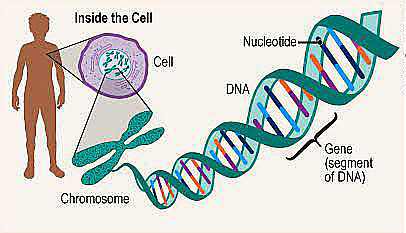
Each nucleotide in a DNA melecule has three main components . These are:
Phosphate group
Five carbon deoxyribose sugar (pentose sugar)
Nitrogenous base. These are: adenine, guanine, cytosine and thymine (or uracil). It is noteworthy to state that adenine always pair with thymine (A-T), while guanine pairs with cytosine (G-C). It is this respective pairings that forms the rungs on the DNA's twisted ladder structure.
Together, the phosphate group, pentose sugar, and nitrogenous base forms a nucleotide. The sequence of these nucleotides form the genetic code that determines an organism's characteristics and serves as the gene that is passed from parents to offspring. These genes (sequence of DNA) are situated within the chromatin in the chromosomes.
Chromosome: Chromosomes are thread-like structures present in a cell's nucleus, comprising of the chromatin, DNA and proteins that carry genetic information in the form of genes. The DNA within the chromosomes are tightly wrapped around proteins called histones.
Organisms have got their specific number of chromosomes. In the case of humans, we have 23 pairs of chromosomes. The 23rd pair of human chromosomes determines the sex of an offspring; and are the (XX for females, XY for males) respectively.
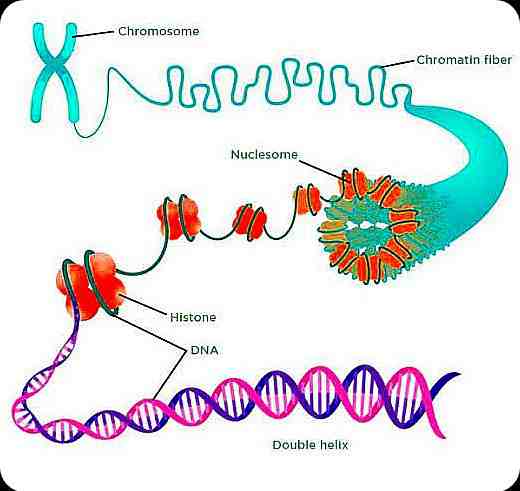
Chromatin: This is a part of the chromosome comprising of a complex of DNA, RNA and protein molecules. In essence, the DNA is packaged within the chromatin allowing its strands to fit properly within the cell's nucleus.
Fun fact: A stretched-out DNA strand from a single human cell is about 6-7 feet (2 meters), and this is longer (or taller) than an average human person. Thanks to its proper packaging in the chromatin granules.
The sequence of DNA (genes) are present and packaged in the chromatin, while the chromatin is situated inside the chromosome.
Please read on the types and functions of nucleus here.
Diploid: This refers to the complete number of chromosomes (2n) in a cell. This number of chromosome in humans is 23 pairs (or 46). Diploid chromosomes is present in all somatic cells.
Haploid: This refers to half the number of chromosomes in a cell. Simply put, it is the condition of having only one set of chromosomes per cell (n).
The number (n) of chromosomes in a human haploid cell is 23. Haploid cells occur only in sex cells (just before fertilization), and results through a type of cell division termed meiosis, which reduces the chromosome number by half. For this reason, the full genetic makeup of offsprings are derived from the haploid sex cells (sperm and egg) of both parents.

Zygote: A zygote is the diploid (2n) cell formed from the fusion of the haploid male and female sex via a process termed fertilization.
Please read on the male accessory sex organs here.
Homologous Chromosomes: These are chromosome pairs inherited from each parent, and will convey similar genes at the same locations (loci). For instance, a homologous chromosome will comprise of a pair of genes responsible for the complexion of the offspring. For this reason, a homologous chromosome may contain different alleles (expressions) since one parent may be fair and the other dark.
However, only the dominant gene (at the same locus) in the homologous chromosome is expressed by the offspring. Therefore, there can be variation of traits in genes at the same locus in an homologous chromosome.
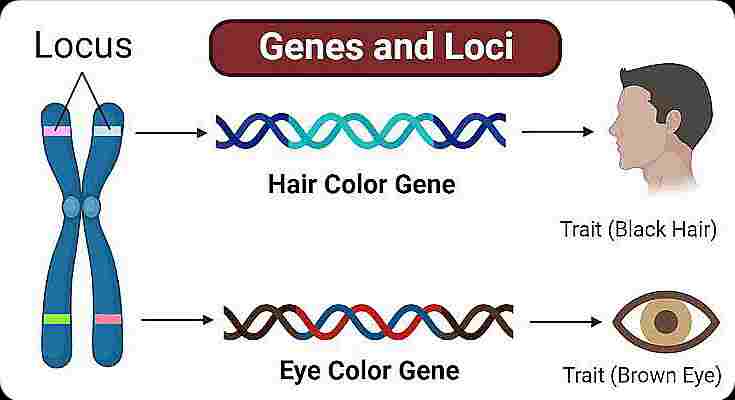
Locus: This is the exact and specific site for the physical location of gene in a chromosome. With regards to alleles (which is simply a pair gene carrying contrasting traits), the locus for white and brown skin color will be on a specific band of a homologous chromosome.
An understanding on loci will prove useful in gene mapping, alongside the diagnosis of genetic conditions.
Chromatid: This is one of the two halves of a duplicated chromosome.

Centromeres: It is the specialized constricted region of a chromatid, that contains the kinetochore. Here, sister chromatids join together after DNA replication. Also, the spindle fibers of a mitotic spindle attach to pull the chromosomes apart during cell division.
You can read on the classification of living organisms here.
Gene: This is the basic unit of hereditary, located on the chromosome, and are passed from parents to offspring via sexual reproduction.
Importantly, genes are primarily made up of sequences of deoxyribonucleic acid (DNA) where they serve as instructions for building proteins, which are crucial for the body's physiology, anatomy, and the expression of traits.
Genotype: This is an organism's complete set of genetic material which serves as a "blueprint" that influences an organism's expression or characteristics. Simply put, the genotype expresses the phenotype.
It is noteworthy to state that offsprings inherit their genetic makeup (genotype) from their parents through sexual reproduction.

Phenotype: The phenotype is the set of observable characteristics (or traits) of an organism, brought about by the organism's genome, alongside the environment where the organism dwell.
In this regard, the phenotype will include the organism's anatomical, physical, biochemical, and behavioral traits.
You can read facts on red blood cells and hemoglobin here.
Allele: You can think of alleles as alternate forms of genes on a homologous chromosome. Simple put, alleles are genes governing variations of the same trait (or characteristic) that occupy corresponding positions (loci) on homologous chromosomes.
Dominant Allele: This allele is always expressed when present, regardless of whether the organism is homozygous or heterozygous for that gene.
Recessive Allele: This allele is not expressed when paired with a dominant allele. In other words, recessive allele is supresed by the dominant allele, and isn't expressed by the organism.
The recessive allele is only expressed when the organism is homozygous for that allele. Meanwhile, it can be passed from parents to offspring.
Codominance: This is an hereditary pattern whereby both alleles for a gene is neither dominant nor recessive. In this regard, both alleles are fully and simultaneously expressed in the heterozygous offspring, giving rise to an equal phenotypic display of both traits. A example is a lamb (offspring of a sheep) with black and white patches on its skin which resulted from the crossing of a black skinned ram and a white skinned ewe.
Another typical example of codominance is seen in the ABO blood group system in humans. For instance, an offspring with type AB blood will inherit both the A and B alleles from the parents with blood group A and blood group B respectively; with both being fully expressed. Recall that both the A and B alleles for blood group expresses both antigens.
Homozygous. An organism possessing a pair of identical alleles for a specific gene is said to be homozygous for such gene.
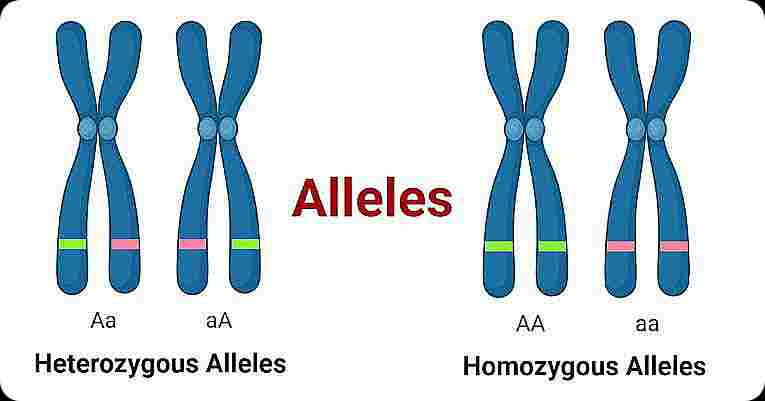
Heterozygous - An organism possessing possessing a pair of different alleles for a specific gene is said to be heterozygous for such gene.
Purebred: This refers to an organism that is homozygous for a particular trait. In this regard, both of its alleles (versions of a gene) are the same.
Sexual reproduction involving two purebred parents will result in the offspring consistently exhibiting the same observable characteristics (phenotype) as the parents. This is in fact the concept of true-breeding.
Please read academic questions and answers for students here.
Carrier: This is an heterozygous individual who possesses a dominant and recessive allele but does not express the recessive allele, character or traits. The point to note is the fact that a carrier still has the recessive gene for a particular trait, though not expressed; but can still be passed to its offspring.
Parent generation (P) : This refers to the crossing of parents through a process that involves the exchange of gametes. In this regard, the offspring inherit traits from both parents. However, some of these traits may be expressed (dominant), while others aren't (recessive).
The parent generation act as suppliers of gametes to the filial generation in hereditary.
Filial generation (F): This generation refers to the offsprings that receive gametes from the parent generation via sexual reproduction. Filial generation can be put into first generation (F1), second generation (F2), third generation (F3) and so on.

Backcross: This is the process of mating a filial generation (F1) with one of its parents, or an individual whose genetyte is very similar to that of its parent; in an attempt produce offspring with a genetic identity closer to such parent.
Backcross is often used in plant and animal breeding to transfer a desirable traits.
Hybrid: This refers to offsprings resulting from the crossing of parents of the different specie subspecies, or breeds, and consequently with different genome. A hybrid offspring shares the traits of both parents, but however, some of these are dominant, while others are recessive.
Examples of hybrids include:
Liger: A cross between a lion and a tiger.
Mule: A cross between a horse and a donkey.
Note: Hybrids may show enhanced traits, such as larger size and greater abilities. This is termed as hybrid vigour.
Hybridization: This is the process of producing hybrid offsprings through the crossing of organisms with contrasting genetic makeup.
Sex-linked Characters: These are characters or traits influenced by genes on the sex chromosomes (X and Y genes). A male human has the XY genes in contrast to the female's XX genes. However, it is noteworthy to state that most of the sex-linked traits are located on the larger X chromosome, and not on the Y chromosome. In this regard, the X chromosome carries more genes than the smaller Y chromosome. Examples of X-linked traits include baldness, color blindness and hemophilia.
Since males have only one X chromosome, they will therefore express any allele on their X chromosome, be it dominant or recessive. Females on the other hand have two X chromosomes, and as a result, must inherit two copies of a recessive allele to express the specific trait, or one copy to be a carrier, whilst the dominant gene is expressed.
Genetic mutation: This refers to a permanent change to an organism's DNA sequence, and consequently, genotype of the organism. Mutation may occur as a result of errors in DNA replication, or exposure to radiation and harmful chemicals. These changes may alter the organism's traits, bringing about new characteristics, and giving rise to genetic diseases.
Meanwhile, understand that the effects of mutations may be beneficial, harmful or neutral. In fact, the concept of evolution in biology results from mutation.
Kindly share this article via the links below:

Please click here to contact Alfred if you require any of the following services:
If you need a standard website at an affordable price.
Online training on the academic subjects: biology, chemistry and basic science.
If you require an advanced smart school management system (web application) for your school.
Click here to read on Len Academy Smart School Software.
Please click here to follow Len Academy on Google News.
Amazing facts in Biology
Russia is home to the largest area of forest in our world with a land mass of 815 million hectares

Giant squid lives deep in the ocean and they have the largest eyes in the world
The movements of the fingers are controlled by muscles of the palms and forehands

Platypus (sometimes referred to as the duck-billed platypus) is an egg-laying, semiaquatic mammal found in eastern Australia. It has no stomach and as such, its food goes from the mouth through the esophagus and directly to their intestines.

Pufferfish contain a toxin called tetrodotoxin. This makes them foul tasting and poisonous to predators. Tetrodotoxin is about 1,200 times more poisonous than cyanide, and there is enough toxin in one pufferfish to kill 30 adult humans. Unfortunately, there isn't any known antidote to this poison.
Interestingly, a delicacy in Japan (called fugu) is made from pufferfish. This meal is very expensive, and must be prepared by trained and licensed chefs. An improper preparation of fugu may lead to the customer's death. Sadly, such deaths are recorded annually

Wombats are the only animal with a cube-shaped poo. They can stack up these cube-shaped poo, marking their territory with it

Robert Wadlow (1918–1940) remains the tallest man ever recorded in the Guinness World Records. He was an American who stood at 8 feet, 11 inches.
An abnormally enlarged pituitary gland had resulted into Robert Wadlow's giant size.
Cockroach is the fastest land animal on six legs

Like humans, all apes laugh when tickled

An ostrich's eye is bigger than its brain
Notable points in Biology

An artery is composed of three layers:
The outermost layer is termed tunica adventitia (or tunica external). It consist mainly of collagen fibres and connective tissues that anchors the arteries to other nearby tissues.
The middle layer is named tunica media. It is made up of smooth muscles and elastic fibres that supports the artery in conveying blood at high pressures.
The inner layer is called tunica intima (or tunica internal). It is lined by a smooth tissue called endothelium, and is made up of a fine network of connective tissues.
All living organisms possess various features in order to survive in their environment. This is the concept of adaptation. As an instance, a fish is able to live in water because it has gills and fins.
Also, a camel is able to survive in the desert because it has large feet to aid walking on sand without sinking. It also has long eyelashes to help protect it from the blowing sand and wind.
Plants are also able to live in different habitats because they have the required adaptive features towards that habitat. For instance:
Plants that live in/on water are termed hydrophytes.
Plants that live on land with moderate amount of water are termed mesophytes.
Plants that live on deserts or arid lands are termed xerophytes.
The point is:
All organisms have various features on them that enables them adapt in their habitat
For a thing to be considered living, it must possess all the basic characteristics of life. These include:
Movement
Respiration
Nutrition
Irritability or Sensitivity
Growth
Excretion
Reproduction
Death
Adaptation
Competition
Please read the explanations on all the basic characteristics of life here
During strenuous exercises like sprinting or running, your body may actually work in the shortage of oxygen. During this time, your body owes oxygen (called oxygen debt) and it must be replenished or repayed after the exercise is stopped. This is why you breathe excess of oxygen after you stopped the exercise.
This is the concept of anaerobic respiration

A food chain is a diagram that shows the relationship between plants and animals within a habitat on the basis of how they rely on each other for food.
Note: Habitat is a place where an organism live. It is of three types: