 Alfred Ajibola
- 22nd June, 2026 @ 04:20 PM
Topics in Basic Science
Classifications of Drugs, Sources of Drugs and Drug Abuse Teeth, Structure of the Tooth, Dentition and Dental Care Balanced Diet, Classes of Food and their Importance Classes of Food, their Composition and Functions Nutrition: Types and Class of Food Cleanliness of parts of the body Family Health and Personal Cleanliness Behaviors and Feelings during Adolescence Pubertal changes in Boys and Girls Classification and Uses of Rubber Characteristics, Classification and Uses of Plastics Cement: Composition, Types and Uses of Cement Types, Properties and Uses of Ceramics Properties and Uses of Nonmetals Safety Devices: Examples and Uses of Safety Devices Accident Prevention Techniques and Safety Rules Safety Precautions for Pedestrians, Cyclists and Motorists Technology: Benefits of Technology Alloys: Types, Composition and Uses of Alloys Ferrous and Non-Ferrous MetalsAcademic Questions in Basic Science
Which of the following diseases is associated with river blindness?
A. Anthrax
B. Lawnmower Disease
C. Onchocerciasis
D. Devil's Crunch
E. Trypanosomiasis
F. Tularemia
The vector for yellow fever is _____.
A. Aedes Mosquito
B. Female Anopheles Mosquito
C. Plasmodium
D. Flavivirus
E. Black Fly
F. Bacillus Anthracis
The bones of the head and face make up the skull. These bones are _____ in number.
A. 12
B. 14
C. 16
D. 18
E. 20
F. 22
Bacteria are not a constituent of our environment.
A. True
B. False
Below are types of drugs. Which of these is considered as pain killers?
A. Stimulants
B. Depressants
C. Opiods and Morphine Derivatives
D. Hallucinogens
E. Anabolic Steroids
F. Cannabinoids
Which of the following statement is false concerning drugs?
A. Drugs can be inhaled
B. Drugs can be injected directly into the bloodstream
C. Drugs can be eaten
D. Drugs exist exclusively in the forms of tablets and syrups
E. Drugs can be placed under the tongue
F. Drugs can be taken with water or another liquid
Vaccination involves a process of introducing pathogens or germs into a person in order to prevent such person from the diseases they cause.
A. True
B. False
With regards to the human health, foreign bodies are best regarded as _____.
A. International bodies
B. Antilators
C. Antibodies
D. Antigens
E. Antibiotics
F. Antidotes
Rubber is defined as an organic material that is very elastic, versatile, and known for its toughness and resilience. This implies that a rubber can be stretched easily, and will return to its original length when it is released after being stretched.
Please read on nonmetals and their uses here.
Rubber shows the following characteristics:
They are highly elastic, and thus can stretch significantly without any deformity, even as it returns to its original shape and size.
They are poor conductors of electricity. For this reason, they can be used as gloves when working with electricity. They can also be used as insulators for shielding wires.
They have high tensile strength, making them resistant to tears. This makes it a key reason they are widely used as car tyres.
Its spring-like nature makes it ideal as a shock absorber. In this regard, they are often associated with children fun centres.
They can act as an effective barrier to heat. For this reason, they may be used as handles of cooking utensils.
They are quite impermeable to water and air. They therefore allow low gas permeability, making them ideal in the production of tube tyres and balloons.
They are resistant to corrosion (rusting), chemical attacks from steam, dilute acids, and alkalis.
They have lower density than water. This property makes it float on water.
Please read on plastics, their characteristics and uses here.
There are two classes of rubber based on their origin. These: are natural rubber and synthetic rubber.
Natural rubber is derived from latex, a milky liquid obtained from the bark of rubber trees (Hevea brasiliensis). Natural rubber can be used directly, or stabilized, or converted into crepe rubber.
Rubber tapping is the process of harvesting latex (a milky-white emulsion) from rubber trees by slicing a shallow, downward-sloping groove into the bark. The image below shows the tapping of natural rubber.
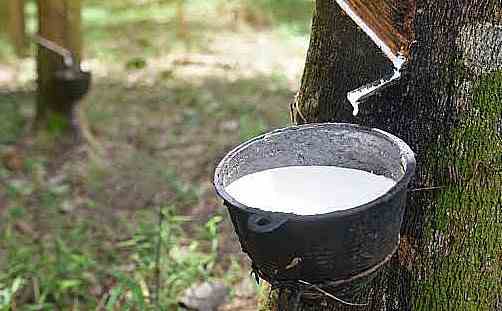
Natural rubber is characterized by high elasticity, and great tensile strength. They also possess low temperature, making them ideal in the manufacture of vehicle tires, adhesives, surgical gloves and footwears.
Please read on cement, types, characteristics and uses here.
These are rubbers artificially derived or polymerized from petroleum (or crude oil). The chemical process that produces artificial rubber is termed polymerization.
Examples of synthetic rubber include Nitrile Rubber (NBR), Neoprene (Polychloroprene), Styrene-Butadiene Rubber (SBR), Silicone Rubber, EPDM Rubber, Butyl Rubber and Polybutadiene.
Synthetic (artificial) rubber are used in the manufacture of inner tubes vehicle tires, shoe soles, roofing systems, football valves, medical stoppers, insulators for wires, liners of tubeless tyres and hoses for fuels.
Please read on the benefits of technology here.
They are used in the manufacture of tyres and tubes. In fact, this is the highest use of rubber globally.
Medically, they are applied in the manufacture of surgical gloves, syringes, and blood pressure cuffs.
They are poor conductors of electricity, making them excellent insulators. In this regard, rubber gloves are worn on the hand to prevent electric shock.
They are used as conveyor belt drives which can act as a pulley, moving heavy materials and goods. Please read on belt and pulley drive here.
They can be used as adhesives, and as specialized bonding agents.
They are applied in the manufacture of shoe soles, factory boots and heel of shoes.
They are used in the production of common and daily use items like rubber bands, footballs, toys, balloons, eraser, etc.
Please the next topic (pubertal changes in boys and girls) here.
Please read basic science scheme of work for jss1 first term here.
Kindly share this article via the links below:
Please click here to contact Alfred if you require any of the following services:
If you need a standard website at an affordable price.
Online training on the academic subjects: biology, chemistry and basic science.
If you require an advanced smart school management system (web application) for your school.
Click here to read on Len Academy Smart School Software.
Please click here to follow Len Academy on Google News.
Amazing facts in Basic Science
According to scientific research, if the first tear drop comes from the right eye, it’s tears of joy. If it comes from the left eye, then it is as a result of pain
Dentistry is the oldest profession in the world. This is considered true because a research conducted by the University of Bologna, Italy on a 14,000-year-old skull found that one rotten tooth in the jaw had been deliberately scoured and scraped with a dental tool
Scientific research has it that the human nose can distinguish more than a trillion different odors

Tigers have striped fur. So also is their skin

The most common wild bird in the world is native to Africa, and it's the red-billed quelea with a population estimated to be around 1.5 billion
Of all animals, mosquitoes hold the record of killing most humans annually. They are responsible for the deaths of 725,000 - 1,000,000 persons yearly
Antibiotics fights and kills bacteria. However, they do nothing to a virus
All insects have six legs. However, dragonfly has six legs but can't walk
The chin is defined as the protruding part of the face below the mouth, formed by the apex of the lower lip. It is shown below:

Interestingly, humans are the only animals with chin

Ripe cranberries will bounce like a ball. For this reason, they are nicknamed 'bounceberries'. They will also float in water
Notable points in Basic Science
We have six classes of food. These are:
Carbohydrates
Proteins
Fats and Oils
Vitamins
Mineral Salts
Water
In humans, roughages are not classified as one of the classes of food. This is so because they aren't digested. Instead, roughages facilitate the movement of bowels in the large intestine (colon); and for this reason, they can become useful in treating constipation.
Food refers to anything that is ingested by living organisms, giving them nutrients and thus enabling them to stay alive.
As an instance, 99% of a panda's diet is bamboo. In this case, bamboo is considered as food to a panda since it provides a source of nutrient and keeps it alive. This is shown in the image below:

The only process in nature that actively enriches our atmosphere with oxygen is photosynthesis. Every other process like respiration, burning and combustion takes away oxygen from it. In addition, they introduce carbon(IV)oxide (CO2) into the atmosphere.
Photosynthesis is also the only process that takes away carbon(IV)oxide (CO2) from the atmosphere.
Photosynthesis is defined as a process by which green plants manufacture food by utilizing carbon(IV)oxide and water in the presence of sunlight.
Oxygen is given off as a by-product of photosynthesis. In regards to this, it is recommended that each person plants a tree.
Matter is composed of particles which can be:
Tightly packed together (as seen in solids).
Loosely packed together (as seen in liquids).
Completely separated (as seen in gases).
The movement of the particles of matter is a function of the overall kinetic energy present in them. You can think of kinetic energy as energy in motion.
An increase in the particles' vibrational, rotational or translational motion will imply an increase in temperature while a decrease in the particles motion (vibrational, rotational and translational) will mean a decrease in temperature. Based on this knowledge, we can therefore define temperature as the measure of the average kinetic energy possessed by the particles of matter.
Intelligence Quotient (IQ) is a score derived from a set of standardized tests developed to measure a person's cognitive abilities in relation to their age group.
IQ may also be defined as the ratio of mental age (MA) to chronological age (CA) multiplied by 100.
Below are some formulas pertaining Intelligence Quotient:
IQ = MA x 100 ÷ CA
MA = Mental age
CA = Chronological age
IQ above 100 = Brilliance
IQ that equals 100 = Average
IQ below 100 = Below Average