 Alfred Ajibola
- 21st August, 2026 @ 04:31 PM
Topics in Basic Science
Classifications of Drugs, Sources of Drugs and Drug Abuse Teeth, Structure of the Tooth, Dentition and Dental Care Balanced Diet, Classes of Food and their Importance Classes of Food, their Composition and Functions Nutrition: Types and Class of Food Cleanliness of parts of the body Family Health and Personal Cleanliness Behaviors and Feelings during Adolescence Pubertal changes in Boys and Girls Classification and Uses of Rubber Characteristics, Classification and Uses of Plastics Cement: Composition, Types and Uses of Cement Types, Properties and Uses of Ceramics Properties and Uses of Nonmetals Safety Devices: Examples and Uses of Safety Devices Accident Prevention Techniques and Safety Rules Safety Precautions for Pedestrians, Cyclists and Motorists Technology: Benefits of Technology Alloys: Types, Composition and Uses of Alloys Ferrous and Non-Ferrous MetalsAcademic Questions in Basic Science
Which of the following diseases is associated with river blindness?
A. Anthrax
B. Lawnmower Disease
C. Onchocerciasis
D. Devil's Crunch
E. Trypanosomiasis
F. Tularemia
The vector for yellow fever is _____.
A. Aedes Mosquito
B. Female Anopheles Mosquito
C. Plasmodium
D. Flavivirus
E. Black Fly
F. Bacillus Anthracis
The bones of the head and face make up the skull. These bones are _____ in number.
A. 12
B. 14
C. 16
D. 18
E. 20
F. 22
Bacteria are not a constituent of our environment.
A. True
B. False
Below are types of drugs. Which of these is considered as pain killers?
A. Stimulants
B. Depressants
C. Opiods and Morphine Derivatives
D. Hallucinogens
E. Anabolic Steroids
F. Cannabinoids
Which of the following statement is false concerning drugs?
A. Drugs can be inhaled
B. Drugs can be injected directly into the bloodstream
C. Drugs can be eaten
D. Drugs exist exclusively in the forms of tablets and syrups
E. Drugs can be placed under the tongue
F. Drugs can be taken with water or another liquid
Vaccination involves a process of introducing pathogens or germs into a person in order to prevent such person from the diseases they cause.
A. True
B. False
With regards to the human health, foreign bodies are best regarded as _____.
A. International bodies
B. Antilators
C. Antibodies
D. Antigens
E. Antibiotics
F. Antidotes
Teeth are bone-like structures embedded in the gums of many vertebrates, and are modified for biting, tearing, grinding and chewing. In this regard, the teeth is defined as a set of hard, enamel-coated structures in the jaws of most animals with with backbone (vertebrates), used for cutting, tearing and grinding.
Below are the types of teeth in humans:
Incisors: These are four flat front teeth used for cutting food.
Canines: These are four pointed (sharp) teeth suitated just after the incisors, and before the premolars. They are used for tearing flesh.
Premolars: These are eight flat teeth used for crushing food. They are suitated just after the canines and before the molars. Together with the molars, they are called the cheek teeth.
Molars: These are the last large twelve teeth with broad surfaces used for grinding food. They are suitated just after the premolars. Included in the molars are 4 wisdom teeth. The wisdom teeth are the third molars which erupts typically between ages 17 and 25. It may be extracted from the mouth due to crowding.
Note: Humans have two sets of teeth. These are 20 milk teeth present in children and 32 permanent teeth in adults.
Please read on nutrition and classes of food here.
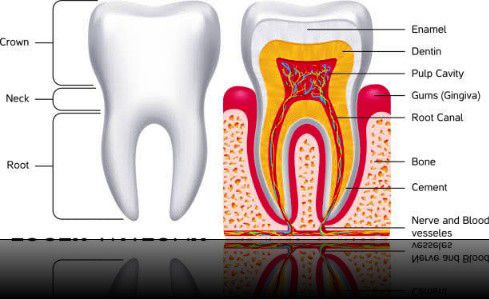
A tooth has two main structural regions. These are: the crown (which is visible), and the root. The crown is the top part of the tooth which we see above our gums. It is used to bite and chew food. The root is the hidden structure under the gum that holds the tooth in place.
The image below show the various structures of the tooth:
You can read on balanced diet and importance of the classes of food
The various layers and tissues of the tooth comprises the following parts:
Enamel: This is the hard, white and shiny covering of the crown of the teeth. The enamel is the toughest tissue in the human body, and it functions to protect the tooth.
Dentine (or Dentin): This is a hard layer just under the enamel. The dentin is the largest part of the tooth. It assists in cushioning chewing pressure, consequently protecting the inner nerves.
Pulp Cavity. This is the soft hollow central part of the tooth containing the sensory nerves and blood vessels. Its blood supply and innervation keeps the tooth alive.
Cement. This is is the structure which fixes the tooth to its socket, glueing it to the jawbone. It is therefore a hard connective tissue covering the outer root. It is also called the cementum.
Periodontal Ligament: These are tiny fibers that hold the root tightly against the jaw bone.
You can read on classes of food, their composition and functions here.
Dentition is defined as the development, number number and arrangement of the different kinds of teeth in the mouth of an organism. We have two types of dentition in animals. These are:
Homodont Dentition: The teeth in an organism's mouth have the same shape, size and structure. Examples are seen in mammalian vertebrates like reptiles (e.g, lizard and alligators), amphibians (e.g, frogs, toads and salamanders), and fishes (e.g, the great white shark and barracuda).
Heterodont Dentition: The teeth in an organism's mouth are differentiated into various sizes, numbers, shapes, forms; and are used for distinct purposes. For example, humans have heterodont dentition in which the teeth are differentiated into incissors (for cutting), canines (for tearing), premolars (for crushing), and molars (for grinding).
Please read on living things (animals) in basic science here.
Below are the characteristics of the various types of teeth in heterodont dentition.
1. Incisors: They show the following characteristics:
They are chisel-shaped and are usually situated in front of the mouth.
Each incisor has one root.
They have broad flat and sharp cutting edge.
They are used for biting and cutting off pieces of food.
They develop from four lobes (three on the labial/facial side and one lingual lobe forming the cingulum).
2. Canines: They show the following characteristics:
Canines are conical and have sharp-point at the tips, as seen in carnivorous animals like dogs, lions, wolves, etc.
They are located just after the incisors, and before the premolars.
They possess the longest and strongest single roots, making them deeply and firmly anchored in the jawbone.
The upper canine (located in the maxilla) are larger and sharper than the lower canine (located in the mandible), which are slightly narrower and longer-crowned.
They are used for tearing flesh, and are consequently absent in herbivores like ruminants.
You can read on pubertal changes in boys and girls in basic science here.
3. Premolars: They show the following characteristics:
They have broad and flat surfaces with pointed sides.
Most premolars have a single root. However, the maxillary first premolar is an exception, since it commonly features two roots.
They act as a bridge to crush, shear, and grind food before it reaches the back molars.
4. Molars: They show the following characteristics:
They are the largest, strongest, and most posterior teeth in the human mouth.
Molars have broader surfaces than the premolars.
They possess between 4 and 5 distinct chewing bumps (cusps) on the occlusal surface.
They are used for crushing and grinding food. For this reason, they are absent in infants.
You can read on metals and their characteristics here.
A dental formula is a formula which shows the actual number and arrangement of the different kinds of teeth in the upper and lower jaws in one half of the mouth. In this regard, the dental formua lists teeth for one side (half) of the upper and lower jaws.
Dental formula is represented as a fraction (or ratio) multiplied by two (so as to calculate its value for both sides of the jaw).
The numerator in this fraction are the teeth in the upper jaw in one half of the mouth, and the denominator represents those of the lower jaw.
Note: You can think of dental formula as a shorthand method typically used to express the number and types of teeth in a mammal.
When reading a dental formula, "I" stands for incissors, "C" for canine, "PM" for premolars, and "M" for molars. Dental formula use capital letters for permanent teeth and small (lowercase) letters for baby or deciduous teeth.
Below are the dental formula of some animals:
Man: I 2/2, C 1/1, PM 2/2, M 3/3 = (16 × 2) = 32
Dog: I 3/3, C 1/1, PM 4/4, M 2/3 = (21 × 2) = 42
Rabbit: I 2/1, C 0/0, PM 3/2, M 3/3 = (14 × 2) = 28
Cow: I 0/4, C 0/0 or 0/1, PM 3/3, M 3/3 = (16 × 2) = 32
You can attempt various questions and answers on basic science here.
Dental care is the maintenance of a healthy mouth, including the teeth, gums, and tongue. The decaying of teeth is caused by bacteria which breaks down and ferment sugars into acids within the teeth, causing pains, weakening, and consequent decay or removal of the tooth if not treated.
You can read on tooth structure and care of the teeth here.
Tooth decay can be prevented by adequately caring for the teeth. The teeth can be cared for through the following ways:
Proper brushing of the teeth twice daily with a good toothbrush and toothpaste.
Avoidance of sugary food since bacteria feed on sugars, converting it into acids that attack the teeth.
Periodic washing of the mouth with hydrogen peroxide to remove kola and tobacco stains.
Regular eating of vegetables, fresh fruits and balanced diet.
Avoid misuse of the teeth through opening of bottle corks with it.
Daily use of dental floss to reach plaque and food pieces stuck between the innermost part of the teeth where the toothbrush cannot fit.
Drinking of adequate water to help wash away food particles. This also keeps the mouth hydrated.
Visit the dentist at least once a year.
Please read the next topic (drug abuse) here.
Please read read basic science scheme of work for jss1 first term here.
Kindly share this article via the links below:
Please click here to contact Alfred if you require any of the following services:
If you need a standard website at an affordable price.
Online training on the academic subjects: biology, chemistry and basic science.
If you require an advanced smart school management system (web application) for your school.
Click here to read on Len Academy Smart School Software.
Please click here to follow Len Academy on Google News.
Amazing facts in Basic Science
According to scientific research, if the first tear drop comes from the right eye, it’s tears of joy. If it comes from the left eye, then it is as a result of pain
Dentistry is the oldest profession in the world. This is considered true because a research conducted by the University of Bologna, Italy on a 14,000-year-old skull found that one rotten tooth in the jaw had been deliberately scoured and scraped with a dental tool
Scientific research has it that the human nose can distinguish more than a trillion different odors

Tigers have striped fur. So also is their skin

The most common wild bird in the world is native to Africa, and it's the red-billed quelea with a population estimated to be around 1.5 billion
Of all animals, mosquitoes hold the record of killing most humans annually. They are responsible for the deaths of 725,000 - 1,000,000 persons yearly
Antibiotics fights and kills bacteria. However, they do nothing to a virus
All insects have six legs. However, dragonfly has six legs but can't walk
The chin is defined as the protruding part of the face below the mouth, formed by the apex of the lower lip. It is shown below:

Interestingly, humans are the only animals with chin

Ripe cranberries will bounce like a ball. For this reason, they are nicknamed 'bounceberries'. They will also float in water
Notable points in Basic Science
We have six classes of food. These are:
Carbohydrates
Proteins
Fats and Oils
Vitamins
Mineral Salts
Water
In humans, roughages are not classified as one of the classes of food. This is so because they aren't digested. Instead, roughages facilitate the movement of bowels in the large intestine (colon); and for this reason, they can become useful in treating constipation.
Food refers to anything that is ingested by living organisms, giving them nutrients and thus enabling them to stay alive.
As an instance, 99% of a panda's diet is bamboo. In this case, bamboo is considered as food to a panda since it provides a source of nutrient and keeps it alive. This is shown in the image below:

The only process in nature that actively enriches our atmosphere with oxygen is photosynthesis. Every other process like respiration, burning and combustion takes away oxygen from it. In addition, they introduce carbon(IV)oxide (CO2) into the atmosphere.
Photosynthesis is also the only process that takes away carbon(IV)oxide (CO2) from the atmosphere.
Photosynthesis is defined as a process by which green plants manufacture food by utilizing carbon(IV)oxide and water in the presence of sunlight.
Oxygen is given off as a by-product of photosynthesis. In regards to this, it is recommended that each person plants a tree.
Matter is composed of particles which can be:
Tightly packed together (as seen in solids).
Loosely packed together (as seen in liquids).
Completely separated (as seen in gases).
The movement of the particles of matter is a function of the overall kinetic energy present in them. You can think of kinetic energy as energy in motion.
An increase in the particles' vibrational, rotational or translational motion will imply an increase in temperature while a decrease in the particles motion (vibrational, rotational and translational) will mean a decrease in temperature. Based on this knowledge, we can therefore define temperature as the measure of the average kinetic energy possessed by the particles of matter.
Intelligence Quotient (IQ) is a score derived from a set of standardized tests developed to measure a person's cognitive abilities in relation to their age group.
IQ may also be defined as the ratio of mental age (MA) to chronological age (CA) multiplied by 100.
Below are some formulas pertaining Intelligence Quotient:
IQ = MA x 100 ÷ CA
MA = Mental age
CA = Chronological age
IQ above 100 = Brilliance
IQ that equals 100 = Average
IQ below 100 = Below Average