 Alfred Ajibola
- 19th May, 2025 @ 10:44 AM
Topics in Agricultural Science
Flowers in Plants, Functions and Pollination The Leaf, Parts and Functions of the Leaf Plant Stem, Types and Functions of the Stem Parts of a Plant: Root, Types and Functions of the Root Ranching, Advantages and Disadvantages of Ranching Ley Farming, Advantages and Disadvantages Pastoral Farming: Nomadic Farming, Advantages and Disadvantages Mixed Farming, Advantages and Disadvantages Agroforestry: Taungya System of Farming, Advantages and Disadvantages Principles and Importance of Crop Rotation Multiple Cropping, Types, Advantages and Disadvantages Continuous Cropping, Advantages and Disadvantages Mixed Cropping, Types, Advantages and Disadvantages Arable Farming: Monocropping, Advantages and Disadvantages Types of Agricutural practices in Localities: Shifting Cultivation, Advantages and Disadvantages Types of Agriculture: Subsistence and Commercial Agriculture Branches of Agriculture Meaning, History and Importance of Agriculture Agricultural Science Scheme of Work for JSS1, First Term Digestive system and stomach compartment in ruminantsAcademic Questions in Agricultural Science
The ideal pH for the optimum growth of most agricultural crop is between _____.
A. 1 – 3.5
B. 4 – 5.5
C. 6 – 7.5
D. 8 – 9.5
E. 10 – 11.5
F. 12 – 13.5
People who go about their lives by raising and herding livestock such as cattle, sheep and goats are said to practice _____.
A. Pastoralism
B. Pasturalism
C. Herding
D. Herdsmen
E. Animalism
F. Anime Farming
The act of giving birth in pigs is called _____.
A. Calving
B. Piggery
C. Kidding
D. Farrowing
E. Calfing
F. Pigging
Which of the following is not a vegetable?
A. Cashew
B. Cocumber
C. Tomatoes
D. Carrot
E. Squash
F. Eggplant
All plants are crops.
A. True
B. False
In agriculture, macronutrients are essential nutrients required by plants. Which of the following is not a macronutrient?
A. Zinc
B. Sulphur
C. Calcium
D. Phosphorus
E. Potassium
F. Magnesium
Which of the following is false concerning micronutrients?
A. They are non-essential nutrients
B. They are required by plants in minute quantities
C. Iron is a micronutrient
D. Chlorine is a micronutrient
E. Copper is a micronutrient
F. Boron is a micronutrient
_____ is a term that describes the biological, chemical and cultural control tactics employed to make pest management economical, environmentally friendly and socially acceptable.
A. Integrated Pest Management
B. Integral Pest Management
C. International Pest Management
D. Inclusive Pest Management
E. Imbibed Pest Management
F. Inclusion Pest Management
When you stroll through a garden or a forest, you may notice an incredible variety of plants. These plants can be categorized into two main groups: monocots and dicots. Understanding the differences between these groups not only enhances your appreciation of the plant kingdom, but also equips you with knowledge that can be useful in fields like biology, agriculture, and gardening.
Monocots and dicots are terms that refer to the two major groups of flowering plants known as angiosperms. This classification is primarily based on the number of cotyledons (seed leaves) that the plant has during its early development stage. The cotyledons of both monocots and dicots are summarized below:
Please read on the differences between gymnosperms and angiosperms here.
As the name suggests, monocots have one cotyledon. This group includes plants such as grasses, lilies, orchids, and palms.
Monocots are usually characterized by their narrow leaves with parallel veins, fibrous root systems, and flower parts that typically appear in multiples of three.

In contrast, dicots have two cotyledons. This group includes a vast array of plants such as roses, sunflowers, beans, and oak trees.
Dicots are typically easily identified by their broader leaves, which often feature a network of branching veins, a taproot system, and flower parts generally appearing in multiples of four or five.
While the cotyledon count is the primary distinguishing feature, there are several other characteristics that set these two groups apart. These are explained below:
1. Leaf Structure
Monocots exhibit long, narrow leaves with parallel veins, giving them a more streamlined appearance.

Dicots, however, have broader leaves featuring a reticulated vein pattern that resembles a network, helping in efficient water distribution and photosynthesis.
Please read on photosynthesis and autotrophic nutrition in plants here.
2. Root System
Monocots usually develop fibrous root systems, which consist of many tiny roots that spread out. This helps anchor the plant while allowing it to absorb water and nutrients efficiently.

However, dicots tend to have a taproot system, where a single, thick root grows deep into the soil with smaller lateral roots branching off, which can help reach deeper water sources.
3. Vascular Tissue Arrangement
The arrangement of vascular tissues (that is: xylem and phloem) is distinct in both groups. In monocots, vascular bundles are scattered throughout the stem.

In contrast, dicots display vascular bundles arranged in a circular pattern, providing structural support and allowing for secondary growth.
4. Reproductive Features
Flowers are the reproductive structures in plants; and this is another area where monocots and dicots diverge significantly.

Monocots often have flowers with parts in multiples of three: such as three petals and three sepals, while dicots usually have flower parts in groups of four or five. This can greatly influence pollination strategies and interactions with various pollinators.
Please read more on sexual reproduction in plants here.
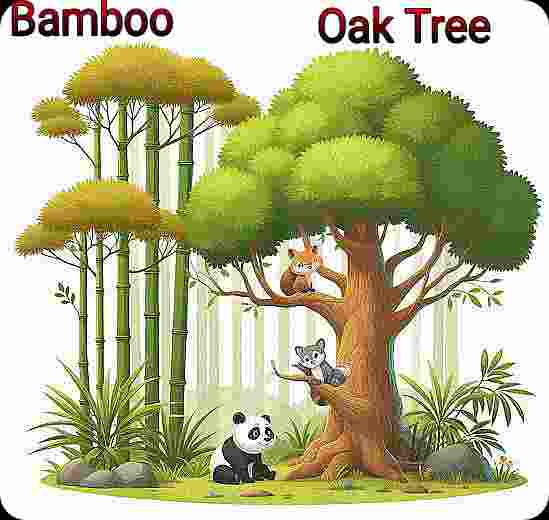
To make learning about monocots and dicots even more interesting, consider this: bamboo, a type of monocot, is one of the fastest-growing plants in the world, while oak trees, classified as dicots, can live for hundreds of years, and play a vital role in supporting local ecosystems. Both trees are shown below:
You can read interesting facts for students here.
In agriculture, the distinction matters greatly, as monocots include staple crops like wheat, corn, and rice, essentially feeding billions around the globe. However dicots include leguminous and beautification crops, alongside other food crops. Examples are beans, groundnut, carrot, rose, sunflower, avocado, blackberry, apples, almonds, potatoes, oak trees and so on.
Understanding the characteristics of these plant groups can assist students studying botany or those interested in gardening, as it informs planting practices and plant care.
You can attempt Len Academy questions and answers on various subjects here.
In conclusion, the world of plants is richly diverse, and knowing the differences between monocots and dicots enriches our understanding of nature. Whether you're a budding botanist or a casual observer, the next time you find yourself in the great outdoors, take a moment to appreciate the unique characteristics that categorize the plants around you!
Kindly share this article via the links below:
Please click here to contact Alfred if you require any of the following services:
If you need a standard website at an affordable price.
Online training on the academic subjects: biology, chemistry and basic science.
If you require an advanced smart school management system (web application) for your school.
Click here to read on Len Academy Smart School Software.
Please click here to follow Len Academy on Google News.
Amazing facts in Agricultural Science
Cows technically have one stomach, not four. However, a cow's stomach has four compartments. These are: rumen, reticulum, omasum and abomasum
Peanuts are legumes and not nuts
Although plants neither see nor hear, they can recognize their siblings and even give them preferential treatments
Squirrels do plant more trees (through their actions) than an average human in their lifetime. They often hide their acorns and nuts underground and forget about them
Cows have got the ability to walk up stairs, but not down stairs
A group of cows is called a team, drove or herd.
People just prefer to call them herd
Notable points in Agricultural Science
Below are characteristics of gymnosperms:
Their seeds have cones that protect them.
Sepals and petals aren't present in their cones.
Stigma and style are absent.
They do not produce fruits. Only seeds are formed.
Companion cells are absent.
Sporophyll form the cones.
Anther and filament are absent.
The ovules are not present in the ovary.
Gymnosperms do not possess flowers.
Please read on the anatomical differences between gymnosperms and angiosperms here
The flower is the reproductive organ in plants' sexual reproduction. In order to achieve a successful sexual propagation or reproduction in plants, the floral parts of the flower are utilized.
The floral parts of a flower consists of the followings:
Sepals
Petals
Stamen
Carpel
The stamen is male portion of a plant. It consists of the anther and filament.
The carpel (or pistil) is the female portion of the plant. It consists of the stigma, style and ovary.
An organism will be considered a pest if it does one of the followings:
Attack crops and eat its seeds, roots, stem, leaves and flowers. Examples are locust and grasshoppers.
Cause damage to stored food, fruits or other agricultural produce. Some may even urinate or deaficate on these products. Examples are rodents, cockroaches and mice.
Attack and kill farm animals like goats, sheep and cattle. Examples are foxes, wild cats and snakes.
Act as disease vectors. A vector is an organism that carries parasite and other disease causing organisms, without being affected; but when they introduce the parasites into their host, such host becomes infected with disease. Examples of vectors are rodents and mosquitoes.
Below are the classification of crops based on their uses:
Oil crops
Vegetable crops
Latex crops
Drug and Medicinal crops
Beverage crops
Fibre crops
Fruit crops
Root and Tubers
Legumes
Spices
Cereals
All crops are plants but not all plants are crops. Below are some instances:
Weeds are considered as plants, not crops.
Parasitic plants are not necessarily crops. Examples of parasitic plants include mistletoe, corpse flower and striga.
Carnivorous or insectivorous plants are not necessarily crops. Examples are sundew, venus flytrap and pitcher plant. The image below shows a carnivorous plant (venus flytrap).

Meanwhile, always understand that all crops are plants, and they are grown for food, money or something beneficial.