 Alfred Ajibola
- 28th December, 2025 @ 12:31 PM
Topics in Home Economics
PVS Examination for JSS1 First Term Exercise: Types, Importance and Guidelines for exercising the body Posture: Importance and Guidelines for a Good Posture Fatigue, Rest and Sleep The Skin:Types, Functions, Care of Skin and Skin Infections The Skin: Layers, Functions, Care and Skin Injuries Tooth Infection: Causes and Prevention of Tooth Infection The Tooth: Structure, Type, Functions and Care of the Teeth Feet, Nails and Pedicuring The Hands, Nails and Manicuring The Ear and Nose: Structure, Functions and Care of the Ear and Nose The Eye: Structure, Functions, Care of the Eye and Eye Defects in Humans Hair Infection; Types, Treatment and Prevention of Hair Infections The Hair: Types, Functions, and Care of the Hair Careers in Home Economics and Importance of Home Economics Introduction to Home Economics Home Economice Scheme of Work for JSS1, First Term Aims and Objectives of Home Economics: Topics covered in Home Economics Bloating: Factors that causes bloating and its treatment How to prepare the Nigerian coconut riceAcademic Questions in Home Economics
The ear is a sense organ and an organ of hearing. It is divided into three parts. These are:
The outer ear
The middle ear
The iinner ear
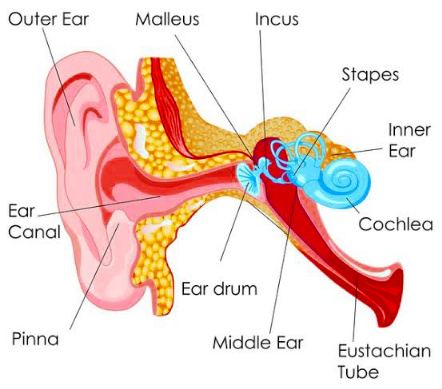
The outer ear is funnel like in shape and comprises of an elastic cartilage. It picks sounds waves or vibrations which are carried to the ear drum. The eardrum act as a boundary between the outer ear and the middle ear.
The middle ear is made up of three small bones called ossicles. These bones are: malleus, incus and stapes respectively. The sound wave passes through the middle ear to the inner ear, and eventually to the brain through the auditory nerve.
The tiny hairs at the entrance of the outer ear alongside the wax in its passage trap dust, fine particles, insects and objects that may enter the inner ear.
Please read on the eyes in home economics here.
Below is a diagram showing the structures of the ear.
It is used for hearing.
It helps to maintain balance.
The shape of the outer ear helps in determining the direction of sounds.
It equalizing air pressure for optimal eardrum vibration through the eustachian tube which connects the middle ear to the throat.
Please read on the hands and nails here.
The outer ears should be carefully washed, cleaned and dried daily.
Do not put any sharp object into the ear.
A cotton swab should be used to remove dirts from the ear.
See an otolaryngologist, commonly known as an ENT (Ear, Nose, and Throat) doctor when you sense any ear infections.
Please read on the skin in home economics here.
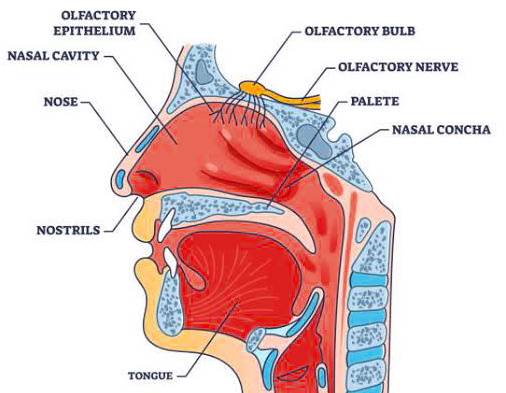
The nose is divided into two nostrils by a partition called nasal septum. The top of the nose consists of bone while the rest are made of cartilage, muscles and skin lined with a fine moist mucous membrane. The lining of the inner membrane contains small glands which produce watery secretion that keeps it moist. The olfactory nerves run from the nose to the brain which helps to perceive smell.
The tiny hairs at the entrance of the nose helps to filter out dust, pollen, germs, and other particles present in air, preventing them from reaching the lungs. These tiny hairs also help to regulate air temperature and humidity by trapping moisture, thus making inhaled air more comfortable.
Please read on the structure and functions of the hair here.
Below is a diagram showing the structures of the nose.
It is used for smelling since it contains specialized olfactory receptors that detect odor molecules and other chemicals.
It is a channel for air passage in and out of the lungs.
The tiny hairs filter dust, germs and other particles in air from entering the nostrils.
It helps in enhancing taste.
It influences speech and sound.
It helps to clear mucus from the paranasal sinuses, throat and tear ducts.
You can attempt Len Academy questions and answers on various subjects here.
Aviod the use of sharp objects on the nose.
Do not poke your nose with your fingernails or any sharp object.
Avoid pricking and plucking the hairs in your nostrils.
Clean your nose with handkerchief or a tissue paper.
See an otolaryngologist, commonly known as an ENT (Ear, Nose, and Throat) doctor when you sense any nose infections.
Drink plenty of water to keep mucus thin and nasal passages moist.
Use saline nasal sprays or a humidifier during dry weather to prevent dryness and irritation.
Breath clean air by avoiding strong chemicals and smokes from cigarettes, cars and polluted environments.
Please read home economics week 6 topic for JSS1 here.
Please read home economics scheme of work for jss1 first term here.
Kindly share this article via the links below:
Please click here to contact Alfred if you require any of the following services:
If you need a standard website at an affordable price.
Online training on the academic subjects: biology, chemistry and basic science.
If you require an advanced smart school management system (web application) for your school.
Click here to read on Len Academy Smart School Software.
Please click here to follow Len Academy on Google News.
Amazing facts in Home Economics

Pound cake (a type of cake) is traditionally made with each of four ingredients weighing a pound. The ingredients are: one pound of flour, one pound of butter, one pound of eggs, and one pound of sugar respectively. This is why it's called a pound cake
Ice cream was once called cream ice
Sharp knives are safer. They are less likely to cut you that dull knives
Honey is a food that never spoils
Pilule Pet are pills (dietary supplements) that can make your poo smell like chocolate
Peanut oil can be used to make explosives like dynamite

Applesauce
Applesauce was the first food eaten in space by astronauts
The first menu item when McDonald's commenced operations was actually 'hot dogs' and not 'hamburgers'
Notable points in Home Economics