 Alfred Ajibola
- 28th December, 2025 @ 12:39 PM
Topics in Home Economics
PVS Examination for JSS1 First Term Exercise: Types, Importance and Guidelines for exercising the body Posture: Importance and Guidelines for a Good Posture Fatigue, Rest and Sleep The Skin:Types, Functions, Care of Skin and Skin Infections The Skin: Layers, Functions, Care and Skin Injuries Tooth Infection: Causes and Prevention of Tooth Infection The Tooth: Structure, Type, Functions and Care of the Teeth Feet, Nails and Pedicuring The Hands, Nails and Manicuring The Ear and Nose: Structure, Functions and Care of the Ear and Nose The Eye: Structure, Functions, Care of the Eye and Eye Defects in Humans Hair Infection; Types, Treatment and Prevention of Hair Infections The Hair: Types, Functions, and Care of the Hair Careers in Home Economics and Importance of Home Economics Introduction to Home Economics Home Economice Scheme of Work for JSS1, First Term Aims and Objectives of Home Economics: Topics covered in Home Economics Bloating: Factors that causes bloating and its treatment How to prepare the Nigerian coconut riceAcademic Questions in Home Economics
The skin is the largest organ in the human body. It is a sense organ receiving stimulus like touch, pressure, pain, heat and cold respectively. The skin acts a protective barrier, while also producing vitamin D from cholesterol when exposed to the sun's ultraviolet rays.
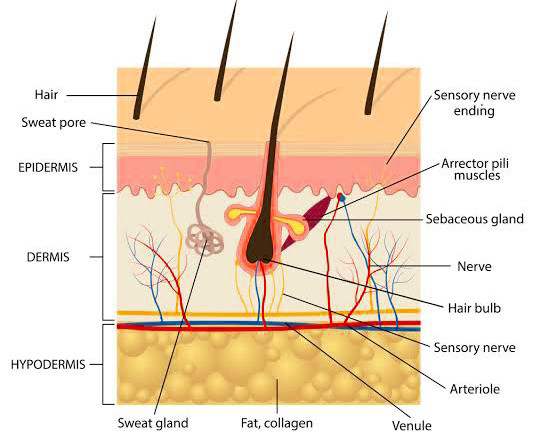
The skin is divided into two layers. These are the epidermis and dermis respectively.
This is the outer layer of the skin, acting as a barrier against pathogens and ultraviolet radiation. It contains melanin which is responsible for the skin color. It is covered with hairs and tiny holes called sweat pores. Sweat or perspiration passes out through the pores, while the hair protects the skin from dust.
Functionally, the epidermis protects the internal bodily organs, while giving coloration to the skin.
Please read on the eyes in home economics here.
This is the inner layer of the skin, and it is directly under the epidermis. It provides support, sensation, and nourishment through its network of blood vessels, collagen fibres, nerves. This makes it important for making the skin firm and flexible. It also receive nervous impulses through its sensory neurones.
Please read on the ears and nose in home economics here.
The dermis contains the following:
Sebaceous Glands: They are also called the oil gland. It produce oil that keeps the skin soft and smooth.
Blood Vessels and nerves: It supply nutrients and oxygen to the upper layer of the skin, while also regulating body temperature. It therefore keeps the skin healthy and helps it to perform its functions.
Sweats Glands: It produces sweat which cools the skin. The sweat gland is an exocrine and apocrine gland.
Adipose Tissue: These are fat deposits under the skin. It reduces heat loss from the body.
Collagen and Elastin: This provides strength (through the collagen fibers) and elasticity (through the elastin fibres) to keep skin firm and flexible.
Hair Follicles: The roots of hair grow from follicles present in the dermis.
Please read on the hair infections in home economics here.
Below is a diagram of the skin.
It protects the internal tissues and organs of the body by acting as the first line of defense against ultraviolet radiation and pathogens.
It acts as a sense organ receiving stimulus like touch, pressure, pain, heat and cold.
It acts as an homeostatic organ by regulating water in the body.
It assists in controlling the body's temperature through the production of sweat.
It synthesizes vitamin D when exposed to sunlight. Vitamin D is important for proper bone formation.
Please read on the hands and manicure in home economics here.
Wash your skin gently during bath. Avoid hard scrubbing with a hard sponge.
Aviod the use of bleaching cream.
Apply mild skin cream or oil daily immediately after bath.
Do not forcefully burst pimples or inflammation so as to prevent redness, swelling and scarring.
Do not stay under ultraviolet radiation for a long duration of time.
Exercise regularly as this helps boost blood flow to the the skin.
Eat healthy meals and a balanced diet.
Catch enough rest; at least seven hours during the night.
Drink plenty of water and always stay hydrated.
Avoid smoking, hard drugs and excessive alcohol.
Consult a dermatologist when skin rashes and other skin infections persist.
Please read on fatigue, rest and sleep here.
This occurs when the skin is opened by sharp objects which results into bleeding. Cuts can be caused by razorblades, knives, broken bottles, glasses, scissors etc.
Wash with antiseptic solution, for example, dettol.
Cover with clean guaze and bandage.
For a large open cut, do not wash. Rather, bandage tightly and see the doctor.
Please read key points in academics on various subjects here.
These are discolorations of the skin without breaking it. It occurs when the body is given a blow with safficient force. There may be very little or no bleeding, but the area affected may become swollen.
Place a clean piece of cloth or handkerchief soaked in very cold water over the braised area.
Cover with a dry dressing wool and bandage to protect the area.
You can read questions and answers for students in basic science here.
These are damage to the skin usually cused by heat. A burn is caused by dry heat. Examples of dry heat are hot iron, electric cooker and fire. A scald is caused by wet heat such as hot water, steam or a solution.
Dip the affected area in cold water.
Do not prick blasters.
Give the person enough fluid to drink.
Serious burns and scalds should get a doctor's attention immediately.
Please read on skin infections, their prevention and treatment here.
These are sharp structures found in various animals capable of infecting venom, usually by piercing the skin of another animal. Examples of animals that sting include wasp, bee, scorpion, mosquitoes, snakes, etc.
Remove the sting from the body by squeezing greatly.
Clean the area with suitable anticeptic solution. For example, TCP and dettol.
Apply a clean bandage and get a doctor's attention immediately.
Please read on home economics week 10 topic for JSS1 here.
Please read on home economics scheme of work for jss1 here.
Kindly share this article via the links below:
Please click here to contact Alfred if you require any of the following services:
If you need a standard website at an affordable price.
Online training on the academic subjects: biology, chemistry and basic science.
If you require an advanced smart school management system (web application) for your school.
Click here to read on Len Academy Smart School Software.
Please click here to follow Len Academy on Google News.
Amazing facts in Home Economics

Pound cake (a type of cake) is traditionally made with each of four ingredients weighing a pound. The ingredients are: one pound of flour, one pound of butter, one pound of eggs, and one pound of sugar respectively. This is why it's called a pound cake
Ice cream was once called cream ice
Sharp knives are safer. They are less likely to cut you that dull knives
Honey is a food that never spoils
Pilule Pet are pills (dietary supplements) that can make your poo smell like chocolate
Peanut oil can be used to make explosives like dynamite

Applesauce
Applesauce was the first food eaten in space by astronauts
The first menu item when McDonald's commenced operations was actually 'hot dogs' and not 'hamburgers'
Notable points in Home Economics