 Alfred Ajibola
- 01st February, 2026 @ 09:22 PM
Topics in Mathematics
Linear Equation in Mathematics Word Problems leading to Algebraic Expression BODMAS in Algebra Multiplication and Division in Algebra Addition and Subtraction in Algebra Multiplication of Number Bases Subtraction of Number Bases Addition of Number Bases Division of Number Base Number Base Conversion Number Base System Significant Figures Rounding Off Numbers Decimal Place Value Fraction Word Problems Word Problems in Fraction Multiplication and Division of Fractions Addition and Subtraction of Fractions Expressing One Quantity as a Percentage of Another Expressing One Quantity as a Fraction of AnotherAcademic Questions in Mathematics

What type of polygon is shown in the above image?
A. Nonagon
B. Decagon
C. Octagon
D. Hexagon
E. Hepagon
F. Pentagon
Which of the following is not part of a circle?
A. Section
B. Sector
C. Segment
D. Semicircle
E. Secant
F. Center

What angle is shown in the above image?
A. Complementary
B. Supplementary
C. Acute
D. Obtuse
E. Reflex
F. Straight
An angle greater than 90o but less than 180o is termed _____.
A. Complementary
B. Supplementary
C. Acute
D. Obtuse
E. Reflex
F. Straight
Factorize 12a2 - 20a + 3
A. (6a - 1)(2a - 3)
B. (6a - 1)(2a + 3)
C. (6a + 1)(2a - 3)
D. (6a + 1)(2a + 3)
E. (-6a + 1)(2a - 3)
F. (-6a + 1)(2a + 3)
Simplify 10ab + 7ab
A. 17ab2
B. 17a2b2
C. 3ab2
D. 3a2b2
E. 17ab
F 3ab
Which of the following is not a type of angle?
A. Right angle
B. Left Angle
C. Acute Angle
D. Complete Angle
E. Straight Angle
F. Reflex angle
Two lines that can never meet each other are best considered as _____ lines.
Rounding off numbers in mathematics refers to the simplification of numbers to a nearby value by targeting their place value, and adjusting the number accordingly, replacing digits to the right with zeros for whole numbers (or dropping them for decimals), such that its value remains close to what it was, thus making them easier to use.
Below are the basic rules for rounding off numbers:
Identify the place value you want to round to (e.g. thousands, hundreds, tens, tenths, hundredth, thousandths and so on).
Look at the digit immediately to the right of that place value. If this digit is 5 or greater (that is: 5, 6, 7, 8, 9): Round up by increasing the target digit (to the left) by one)
If the digit is 4 or less (that is: 4, 3, 2, 1, 0), Round down by leaving the target digit (to the left) just the way it was.
Please read on place value of numbers here.
When rounding off whole numbers, adjust the digits to the right by changing them to zeros. For decimals, drop them.
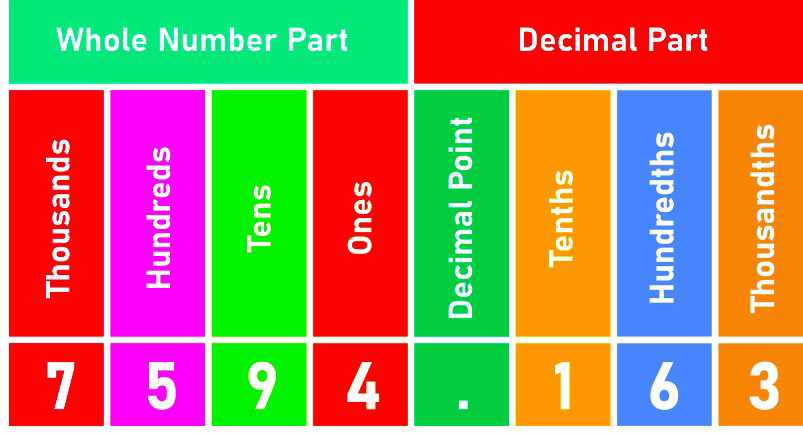
An understanding on the concept of thousands, hundreds, tens, unit, tenth, hundredth, thousandth, and so on are crucial in place values. This is summarized via the image below:
Please read on the factors of numbers here.
Please read on decimal places here.
Example 1
Approximate 179.734 to the nearest:
Hundred
Ten
Whole number
Tenth
Hundredth
Solution
Note: If the digit immediately after the place value is 5 or greater, round up by adding 1. If lesser than 5, round down be leaving the value as it were.
179. 734
To nearest hundred, digit of importance is 1
To nearest ten, digit of importance is the 'first' 7
To whole number, digit of importance is the value before the decimal place, and that's 9.
To nearest tenth, digit of importance is the 'second' 7
To nearest hundredth, digit of importance is 3
Example 2
Solution
To nearest ten, digit of importance is 6
Example 3
Solution
To nearest hundred, digit of importance is the "second" 9.
Example 4:
Solution
To nearest thousand, digit of importance is 6
Example 5
Solution
To nearest unit, digit of importance is 3
Example 6
Solution
To nearest tenth, digit of importance is 9
Example 7
Solution
To nearest hundredth, digit of importance is the 9 after the decimal place.
Example 8
Solution
To nearest thousandth, digit of importance is 4.
Please read on the conversion of decimals to fractions here.
Please read on significant figures here.
Round off the following numbers:
345 to the nearest tens
375 to the nearest tens
695 to the nearest tens
705 to the nearest tens
715 to the nearest tens
6.1 to the nearest whole number
13.3 to the nearest whole number
78.75 to the nearest whole number
26.9 to the nearest whole number
9.5 to the nearest whole number
0.71 to the nearest tenth
0.01 to the nearest tenth
0.15 to the nearest tenth
0.45 to the nearest tenth
0.98 to the nearest tenth
0.614 to the nearest hundredth
0.617 to the nearest hundredth
0.706 to the nearest hundredth
0.702 to the nearest hundredth
0.295 to the nearest hundredth
Please read on mathematics week 7 topic for jss1 first term here.
Please read on mathematics scheme of work for jss1 first term here.
Kindly share this article via the links below:
Please click here to contact Alfred if you require any of the following services:
If you need a standard website at an affordable price.
Online training on the academic subjects: biology, chemistry and basic science.
If you require an advanced smart school management system (web application) for your school.
Click here to read on Len Academy Smart School Software.
Please click here to follow Len Academy on Google News.
Amazing facts in Mathematics
The opposite sides of a dice will always give a sum of seven
31,556,926 seconds makes one year
From 0 through 1000, the only number that has the letter 'a' in it is 'one thousand'
÷
The division symbol '÷' is actually called an obelus
Four is the only number in the English language that is spelt with the same number of letters as the number (4) itself
40 is spelt as forty and not 'fourty'. It is the only number that is spelt with letters arranged in alphabetical order
An odd number is a number that cannot be divisible by 2.
Every odd number has an 'e' in its spelling. They include:
555 in Thailand sounds like 'hahaha'. This is because the number '5' means 'ha' in Thailand
In mathematics, 10! means 10 factorial. Below is its calculation:
10! = 10 x 9 x 8 x 7 x 6 x 5 x 4 x 3 x 2 x 1 = 3628800
Interestingly, 3628800 seconds is the same as 42 days
42 days is the same as 6 weeks
We can therefore say that 10! equals 6 weeks or 3628800 seconds in mathematics
When you multiply 111,111,111 by 111,111,111; the result equals 12,345,678,987,654,321
Notable points in Mathematics
Let's use algebra to explain the simple statement below:
I am a number. When you subtract 3 from me, the result is 9. what number am I ?
Of course we know the answer is 12. You probably guessed it from your mind because it was that simple. The truth is, We could have a much more complicated statement of such; and that is where algebra comes into play.
Now, to apply algebra in the above statement, we use letters or alphabets to represent the unknown number(s). So using algebra, we can write:
Let the number be y
y - 3 = 9
y = 9 + 3
y = 12

The image above shows a right angled triangle. The angle of the above right triangle is denoted as θ. Below are some points to note:
Hypotenuse is always the longest side of the triangle.
Opposite is the side opposite the angle (θ)
Adjacent is the shorter side next to the angle (θ)
Each of Sin θ, cos θ and tan θ are the ratio of sides of the right triangle. They are calculated by using the formula (margic word) sohcahtoa:

soh
Sin θ = Opposite/Hypotenuse
cah
Cos θ = Adjacent/Hypotenuse
toa
Tan θ = Opposite/Adjacent

Circumference in mathematics means the distance around the edge of a circle (or a another curved surface).
Circumference is to circle or any other curved surface

Perimeter means the distance around a square or rectangle or polygon.
Perimeter is to square or rectangle or polygon