 Alfred Ajibola
- 28th December, 2025 @ 12:28 PM
Topics in Home Economics
PVS Examination for JSS1 First Term Exercise: Types, Importance and Guidelines for exercising the body Posture: Importance and Guidelines for a Good Posture Fatigue, Rest and Sleep The Skin:Types, Functions, Care of Skin and Skin Infections The Skin: Layers, Functions, Care and Skin Injuries Tooth Infection: Causes and Prevention of Tooth Infection The Tooth: Structure, Type, Functions and Care of the Teeth Feet, Nails and Pedicuring The Hands, Nails and Manicuring The Ear and Nose: Structure, Functions and Care of the Ear and Nose The Eye: Structure, Functions, Care of the Eye and Eye Defects in Humans Hair Infection; Types, Treatment and Prevention of Hair Infections The Hair: Types, Functions, and Care of the Hair Careers in Home Economics and Importance of Home Economics Introduction to Home Economics Home Economice Scheme of Work for JSS1, First Term Aims and Objectives of Home Economics: Topics covered in Home Economics Bloating: Factors that causes bloating and its treatment How to prepare the Nigerian coconut riceAcademic Questions in Home Economics
The human eye is a sensory organ that captures light and converts it into electrical signals for the brain to interpret as vision, allowing us to see colors, shapes, and depth. It is protected within the orbit of the skull (called the eye socket).
The eye is made up of different parts. Each part performs a specific function.
Below are the external parts of the eye and the functions they perform:
Eyebrow: It prevents sweat from etering into the eyes.
Eyelashes: It protects the eyes from dust and dirt.
Eyelids: It closes to protect the eyes from foreign objects.
Please read on the ear and nose in home economics here.
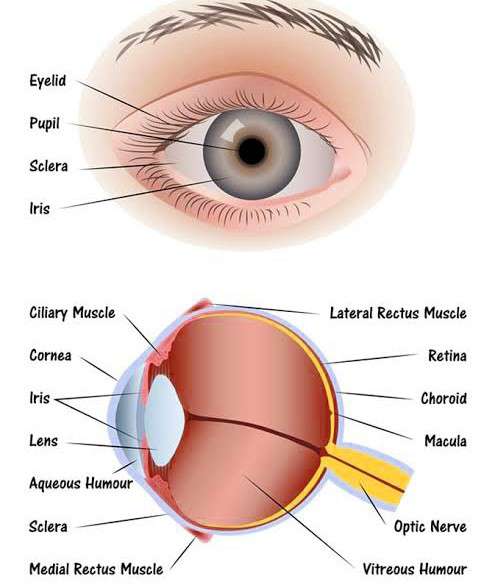
Below are the internal parts of the eye and their functions:
Optic nerves: They transmit electrical impulses from the eye to the brain. Simply put, it sends signal to the brain for interpretation.
Cornea: It directs light into the pupil of the eye. It is a protective layer that keeps dust and dirt from passing through the pupll of the eye.
Iris: It determines the eye colour. It also controls the size and diameter of the pupll by increasing or decreasing it. Through this action, it regulates the amount of light entering the eye.
Pupil: This is the hole in front of the eyeball through which light rays pass into the eye.
Lens: It is a glass-like part of the eyes which focuses the light rays on the retina leading to the formation of the image.
Retina: This is the light sensitive spot where the image is formed.
Aqueous Humor: It is made up of a clear watery liquid. It provides essential nutrients to surrounding tissue. It also help in maintaining the eye's shape and internal pressure.
Virtuous Humor: It is made up of liquid, but larger than that of the aqueous humor. It is present between the lens and retina, making up about 80% of the eyeball's volume. It maintains the shape of the eye, transmits light to the retina, and also support the retina.
Tear gland: It pours out tear over the front of the eye which washes dust particles away from the eyes.
Sclera: This is the white, protective outer wall of the eyeball within the eye socket
Below is a diagram showing the various parts of the eye.
Please read on the skin in home economics here.
Light enters through the cornea, then passes through the pupil and eventually the lens. The lens fine-tunes the focus of this light, making its final bending adjustment to the retina. This creates an image that is smaller and inverted on the retina. The retina converts this image into neural signals.
The optic nerve sends these signals to the brain, which flips the image right-side up, allowing you to see the actual image in reality.
Please read the introduction to home economics and areas covered in home economics here.
Long Sightedness (Hypemetropia): This is inability of a person to see objects that are close, but he or she can see far away (distant) objects.
Short Sightedness (Myopia): This is the inability of a person to see objects that are far away, but he or she can see nearby objects.
Night Blindness (Nyctalopia): This is the difficulty of a person to see in dim light or darkness. Night blindness is not considered a disease in itself, but a symptom of an underlying eye issues like vitamin A deficiency, glaucoma, cataract, or retinitis pigmentosa.
Astigmatism: This is due to the inconsistent or uneven shape of the cornea or lens, resulting to blurry vision. Astigmatism is a common vision issue caused from an irregularly shaped eye (cornea or lens), which looks like a rugby ball instead of a sphere, causing blurry vision at all distances, headaches, and squinting since the light focuses at multiple points on the retina.
You can read on exercise and drugs in home economics here.
The eyes are are used for seeing abjects around us.
It detects visible light from the environment, interpreting different wavelengths as colors.
The feelings of surprise are expressed by the eyes. For example, wide eyes shows surprise while tears expresses sadness or even joy.
Please read interesting facts for students here.
Do not read with a bad light.
Do not rub the eyes with your hands. Rather, wipe it gently with a clean cloth.
Do not look directly at a bright light.
Practice good hygiene by washing your hands thoroughly before touching your eyes or handling contact lenses.
Eat a balanced diet and foods rich in vitamin A. For example, carrot, fish, egg, vegetables, and milk.
Use safety glasses for activities like laboratory work, home repairs, or sports like swimming to prevent injuries.
Wear sunglasses that block at least 99% of ultraviolet radiation on a sunny day.
Adjust your phone and computer screens to proper lighting when working with them over a long period of time.
See the eye doctors which include an ophthalmologist (eye doctors who can perform surgery), optometrists (eye doctor provide vision exams, prescriptions, and treat common issues), and opticians (eye doctor who fit glasses/contacts) on problems with with the eyes.
Always follow your doctor's recommendations for contact lens use and care.
Please read home economics JSS1 topic for week 5 here.
Please read home economics scheme of work for jss1 first term.
Kindly share this article via the links below:
Please click here to contact Alfred if you require any of the following services:
If you need a standard website at an affordable price.
Online training on the academic subjects: biology, chemistry and basic science.
If you require an advanced smart school management system (web application) for your school.
Click here to read on Len Academy Smart School Software.
Please click here to follow Len Academy on Google News.
Amazing facts in Home Economics

Pound cake (a type of cake) is traditionally made with each of four ingredients weighing a pound. The ingredients are: one pound of flour, one pound of butter, one pound of eggs, and one pound of sugar respectively. This is why it's called a pound cake
Ice cream was once called cream ice
Sharp knives are safer. They are less likely to cut you that dull knives
Honey is a food that never spoils
Pilule Pet are pills (dietary supplements) that can make your poo smell like chocolate
Peanut oil can be used to make explosives like dynamite

Applesauce
Applesauce was the first food eaten in space by astronauts
The first menu item when McDonald's commenced operations was actually 'hot dogs' and not 'hamburgers'
Notable points in Home Economics