 Alfred Ajibola
- 18th October, 2026 @ 12:20 PM
Topics in Physics
Time: Simple Pendulum and Ticker-Tape Timer Concept of Time and Ways of Measuring Time Concept of Direction: Scalars and Vectors Position, Distance and Displacement Fundamental, Derived and Supplementary Quantities and Units with Dimensions Measurement of Basic Quantities and Importance of Measurement in Physics Introduction to Physics: Definition, Branches, Importance and Scholars of Physics Derived Units: Similarities and differences with fundamental units Gravity: Facts on Gravity Relative Density of Substances and Specific Gravity Types of Heat Transfer: Conduction Types of Heat Transfer: Convection Types of Heat Transfer: Radiation Physics Scheme of Work, SS1, First Term Physics Scheme of Work, SS1, Second Term Physics Scheme of Work, SS1, Third Term Velocity and Acceleration Newton's Laws of Motion Importance of Gravity What is Density? Density of various substancesAcademic Questions in Physics
Which of the following is a fundamental quantity?
A. Luminous Intensity
B. Area
C. Volume
D. Velocity
E. Concentration
F. Acceleration
An object at rest will temporarily stay in its state of rest, and if the object is in uniform motion, it will temporarily move in a straight line, unless an external force acts upon it.
The above statement refers to Sir Isaac Newton's first law of motion.
A. True
B. False
Which of the following statement is incorrect concerning gravity?
A. The force of gravity is generally considered the strongest force among the four forces that govern the universe
B. Your weight changes as you travel away from the earth
C. If we dig the earth until we get into its center, we will have no weight as a result of lack of gravity
D. Gravity prevents us from falling off the constantly rotating earth
E. If a hammer and a feather are dropped simultaneously in a vacuum, they will both land at the exact same time as a result of gravity
F. Weight is always a function of gravity

Sir Isaac Newton was hit by an apple when he pondered on force, motion and gravity.
A. True
B. False
The movement of gaseous particles through a tiny hole is termed _____.
A. Osmosis
B. Diffusion
C. Effusion
D. Infusion
E. Defusion
F. Gaslusion
A lighted bulb transfers heat through a process termed _____.
A. Conduction
B. Convection
C. Radiation
D. Oxidation
E. Reduction
F. Electrical Induction
A measurement of how much the velocity of an object changes with time is termed _____.
A. Displacement
B. Acceleration
C. Speed
D. Momentum
E. Velocity-Time graph
F. Average velocity
Which of the following differentiates velocity from speed?
A. Distance
B. Time
C. Momentum
D. Inertia
E. Direction
F. Distance and Time
Measurement is defined as the process of comparing an unknown quantity with a standard quantity of the same kind, called a unit. The result is always a "number × unit" (e.g. 5m, 20s, 25°C, 0.2mol). A number without a unit has no physical meaning.
Physical quantity refers to anything that can be measured. It has a magnitude and a unit.
In physics, magnitude refers to the size or numerical value of a physical quantity, and it does not (never) depend on any direction. It answers the question "how much" rather than "which way".
It makes physics quantitative and exact. For example, laws such as "F = ma" can only be tested with numbers.
It allows experiments to be repeated and compared by different people in different places.
It is the basis of trade and commerce. In this regard, buying and selling is done by using quantitative units such as length, mass and volume.
It is essential in engineering and construction, where wrong measurements cause failure.
It is used in medicine and health when giving dosage, measuring temperature and blood pressure.
It supports navigation, weather forecasting, industry and space science.
Note: In physics, SI stands for Système International d'Unités (the International System of Units),.
1. Length
The International System of Units (SI unit) is metre (m). One metre is the distance light travels in vacuum in 1/299,792,458 fraction of a second.
The table below shows various instruments for measuring length, their typical use and accuracy.
| Instrument | Typical use | Accuracy |
| Metre rule | Lengths of about 1m | 0.1 cm |
| Measuring tape | Long distances, cloth, fields | 0.1 cm |
| Vernier callipers | Diameter of a cylinder, inside and outside diameters, depth | 0.01 cm |
| Micrometer screw gauge | Diameter of a wire, thickness of a sheet | 0.01 mm |
A vernier caliper is a precision measuring tool commonly used to measure the internal and external diameter of circular objects, and their depths (in physics laboratories, engineering, and manufacturing).
A venier caliper is also used for measuring:
General linear length, width, and thickness of solid objects.
Step measurements (the height difference between two surfaces).
Below is an image of a venier caliper.
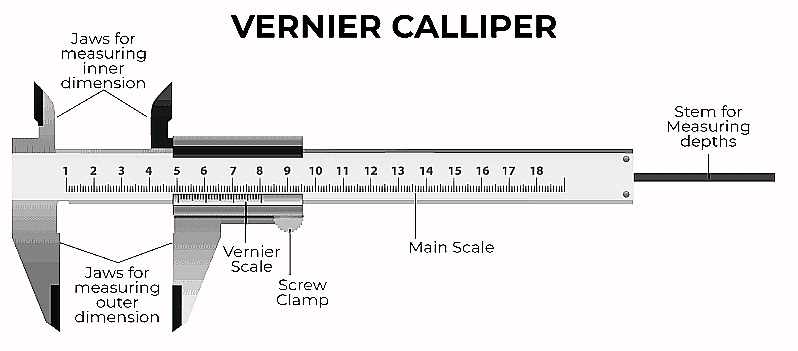
It has a main scale and a sliding vernier scale.
Least count = 1 main scale division − 1 vernier scale division = 0.1 mm = 0.01 cm.
Reading = main scale reading (just before the vernier zero) + (vernier division that coincides × 0.01 cm).
Example: main scale reads 2.3 cm and the 6th vernier line coincides. Reading = 2.3 + (6 × 0.01 = 0.06) = 2.36 cm.
You can read on fundamental physics concepts here.
A micrometer screw gauge is precision measuring tool and standard physics and engineering instrument used to measure very small linear dimensions with high accuracy.
A micrometer screw guage is used for measuring:
Diameter of thin wires. For example, measuring copper or steel wires to check gauge size.
Thickness of metal plates or discs: For example, measuring the thickness of CD, DVD and blue ray disc.
Thickness of paper or foil. For example, measuring sheets of paper, aluminum foil, or plastic film.
Below are images of a micrometer screw gauge.
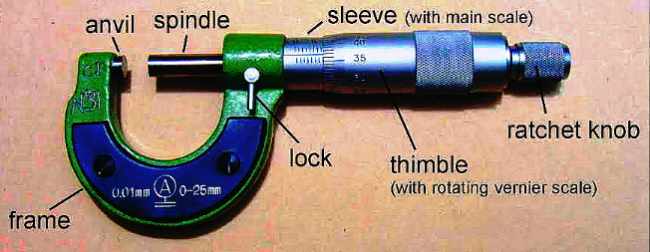
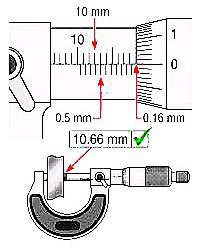
Pitch = 0.5 mm, with 50 divisions on the thimble.
Least count = pitch ÷ number of thimble divisions = 0.5 ÷ 50 = 0.01 mm.
Reading = sleeve (main scale) reading + (thimble reading × 0.01 mm).
Example: sleeve 5.5 mm, thimble 28 Reading = 5.5 + (28 × 0.01) = 5.78 mm.
Note: Always turn the ratchet to avoid over-tightening.
Zero error: This is the reading when the jaws are closed and should read zero.
Positive zero error means the instrument reads above zero. Negative zero error means it reads below zero.
Corrected reading = observed reading − zero error (keep the sign of the error).
Example: Zero error = +0.02 cm and observed = 3.46 cm, so corrected = 3.46 − (+0.02) = 3.44 cm.
You can read an introduction to the concept of velocity and acceleration here.
2. Mass
The International System of Units (SI unit) of mass is kilogram (kg). It is the only base unit that was defined by a physical object (a platinum-iridium cylinder) until 2019. It is now defined using the Planck constant.
Mass is defined as the quantity of matter in a body. It is a scalar quantity, constant everywhere, and does not depend on gravity.
A scalar quantity in physics is a physical measurement that has magnitude only and no direction.
They include beam balance, double beam balance, lever balance, and electronic (digital) balance. These balances compare the unknown mass with known standard masses, so they give the same reading on Earth and on the Moon.
Below is an image of the double beam balance.
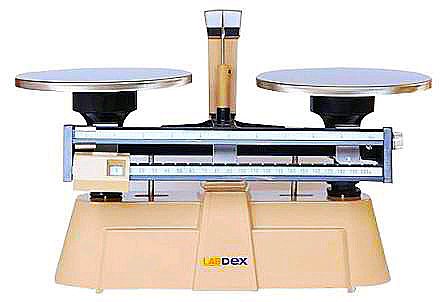
Other units of mass include: gram (g), tonne (t).
Note: Mass and weight are not exactly the same thing.
Please read on density in physics here.
Weight is the force of gravity acting on a body. It equals mass × gravity.
W = mg
Weight is a vector quantity (that is, it has magnitude and direction), pointing towards the centre of the Earth.
The SI unit for weight is newton (N).
A spring balance is used for measuring weight. It works on Hooke's law which states that 'the extension of the spring is proportional to the load'.
The image below shows a spring balance.
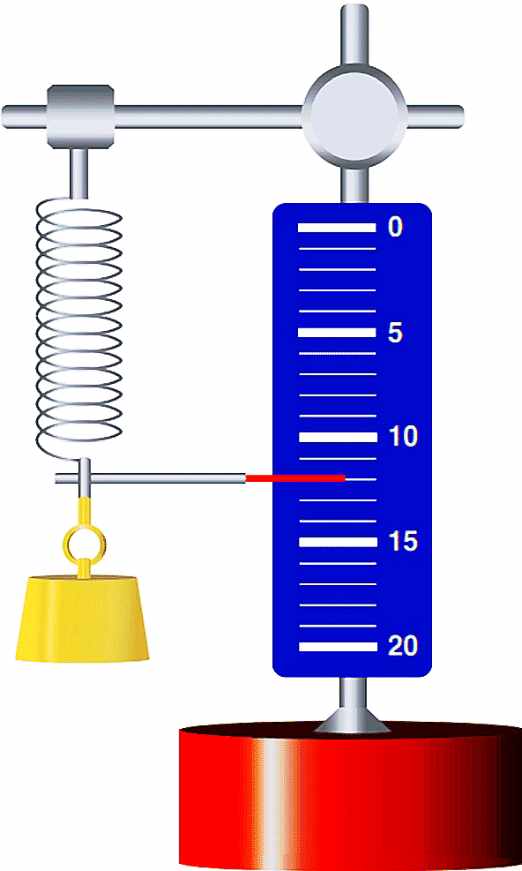
On Earth, gravity (g) ≈ 9.8 m/s² (often taken as 10 m/s²).
On the Moon, g ≈ 1/6 of Earth's value. For example:, a 5 kg body weighs 5 × 10 = 50 N on Earth, but only about (1/6 × 50N = 8.3N) on the Moon. However, its mass still remains 5 kg regardless the location.
Please read on gravity on the solar system here.
The table below shows the differences between mass and weight.
| Mass | Weight |
| Quantity of matter in a body | Force of gravity on the body |
| Scalar quantity (has only magnitude) | Vector quantity (has magnitude and direction) |
| S.I unit is kilogram (kg) | S.I unit is Newton (N) |
| Constant everywhere | Changes with location (g) |
| Measured with a beam or electronic balance | Measured with a spring balance |
Please read fun facts on gravity here.
3. Time
The SI unit: of time is second (s). One second is the duration of 9,192,631,770 periods of the radiation from the caesium-133 atom (atomic clock).
Instruments for measuring time include stopwatch, stop clock, wristwatch, atomic clock.
Below is an image of a stop clock.
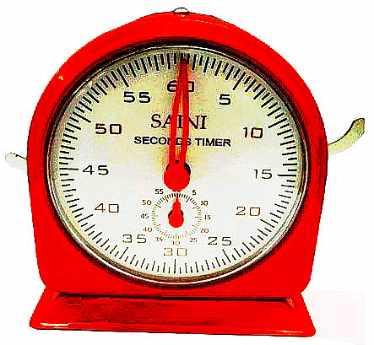
A simple pendulum is used to measure short times. The period is the time for one complete oscillation, T = 2π√(l/g).
Below is image of a simple pendulum used in measuring short times.
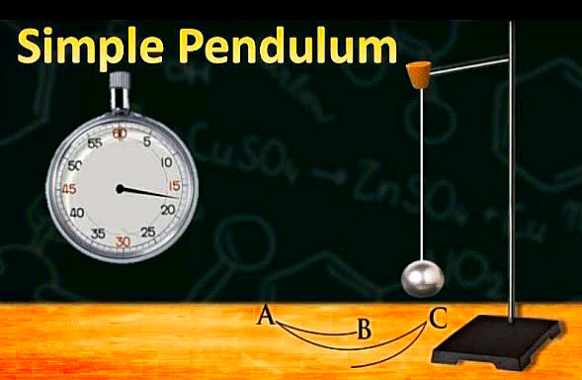
To reduce error when measuring time via a simple pendulum, time 20 oscillations and divide: T = t/20. Start counting from the middle of the swing, because the bob moves fastest there and the start is easiest to judge.
Please read a short note on the concept of motion and speed here.
4. Electric Current
The SI unit of electric current is ampere (A). Smaller units include milliampere (1 mA = 10⁻³ A) and microampere (1 μA = 10⁻⁶ A).
Ampere is defined as the constant current which, in two straight, parallel, infinitely long conductors 1 m apart in vacuum, produces a force of 2 × 10⁻⁷ N per metre of length between them.
The instrument for measuring ampere is the ammeter, connected in series with the component. An ideal ammeter has very low resistance so it does not change the current.
Below is the image of an ammeter.
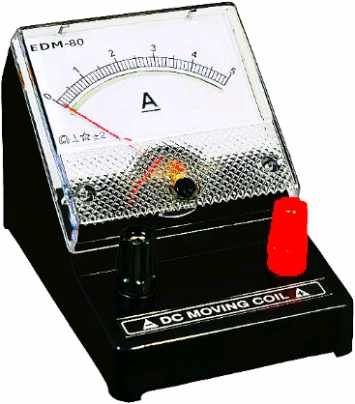
The formula for calculating current is:
Kindly share this article via the links below:
Please click here to contact Alfred if you require any of the following services:
If you need a standard website at an affordable price.
Online training on the academic subjects: biology, chemistry and basic science.
If you require an advanced smart school management system (web application) for your school.
Click here to read on Len Academy Smart School Software.
Please click here to follow Len Academy on Google News.
Amazing facts in Physics
Marie Curie was the first person ever to win two Nobel prizes. She won her first Nobel price for physics in 1903, and the second for chemistry in 1911 for her work on radioactivity.
The hottest temperature ever recorded occurred in Furnace Creek Ranch, Death Valley, California, USA, at 56.7oC or (134oF) on July 10, 1913

A medium-sized cumulus cloud has a weight of about 80 adult elephants.
You can think of cumulus cloud as a detached, individual, cauliflower-shaped cloud often seen in fair weather conditions

The reason the Leaning Tower of Pisa is tilted is the same reason it's still standing
One quarter of an apple is filled with air and that's why they float in water

The Nobel price was named after its founder, Alfred Noble. He is a Swedish, born on October 21, 1833; and was the inventor of dynamite. He was also a a famous scientist and a successful business man.

Glass balls bounce higher than rubber balls
Every planet has its own unique gravitational force. For instance, Mars has a gravity of 3.711 m/s2 while earth’s gravitational force is 9.807m/s2.
When two metals are put together in space, they will stick together as if they are welded. This phenomenon is called cold welding
The fastest animal on land is cheetah. It can reach a maximum speed of about 113km per hour.
Notable points in Physics
The Standard International (SI) unit for density is kilogram per cubic metre (Kg/m3).
The table below shows various substances with their densities:
|
Substance |
Density (Kg/m3) |
|
Helium |
0.179 |
|
Air (1atm and 20oC) |
1.20 |
|
Bamboo Wood |
400 |
|
Ethanol |
810 |
|
Methylated Spirit |
800 |
|
Benzene |
900 |
|
Paraffin Wax |
900 |
|
Ice |
920 |
|
Water (Fresh Water) |
1000 |
Force can be balanced or unbalanced.
When forces from different directions act on an object and consequently bring about the object's motion, then such forces are unbalanced.
Conversely, if theses forces bring about zero motion (static position or no movement) on the object of reference, then it's a balanced force.
In summary,
An apple hanging on a tree (without any form of movement) has a balanced force.
An apple falling from a tree has an unbalanced force.
If one covers a distance of 10,000 meters in 50 seconds and another covers the same distance in 5,000 seconds, we can conclude that the first person has a greater speed because he covered the same distance at a lesser time.
Speed is defined as distance travelled per unit of time. It can also be defined as the rate of change of distance.
Speed = distance/Time
Speed is a scalar quantity since it has only magnitude. Speed does not have a direction.
In physics, motion is defined as a change in the position of an object with reference to time.
Although we sometimes sit or stand in a fixed position, that doesn’t mean motion isn’t taking place. The fact that the earth is constantly rotating implies that we are indirectly moving along with it. We can thus say that motion can be relative to some frame of reference.
In the above paragraph, the earth (constantly rotating along its axis) is our frame of reference and everything present on earth is in motion (with regard to earth as a frame of reference).
Heat is a form of energy. It cannot be lost according to the first law of Thermodynamics; rather it will be transferred. The first and second laws of thermodynamics are stated below:
Energy can neither be created nor destroyed but can be transformed or converted from one form to another.
1st law of thermodynamics
In the course of energy transfer, some energy is lost in the form of heat to the surroundings.
2nd law of Thermodynamics