 Alfred Ajibola
- 22nd October, 2026 @ 04:50 PM
Topics in Physics
Time: Simple Pendulum and Ticker-Tape Timer Concept of Time and Ways of Measuring Time Concept of Direction: Scalars and Vectors Position, Distance and Displacement Fundamental, Derived and Supplementary Quantities and Units with Dimensions Measurement of Basic Quantities and Importance of Measurement in Physics Introduction to Physics: Definition, Branches, Importance and Scholars of Physics Derived Units: Similarities and differences with fundamental units Gravity: Facts on Gravity Relative Density of Substances and Specific Gravity Types of Heat Transfer: Conduction Types of Heat Transfer: Convection Types of Heat Transfer: Radiation Physics Scheme of Work, SS1, First Term Physics Scheme of Work, SS1, Second Term Physics Scheme of Work, SS1, Third Term Velocity and Acceleration Newton's Laws of Motion Importance of Gravity What is Density? Density of various substancesAcademic Questions in Physics
Which of the following is a fundamental quantity?
A. Luminous Intensity
B. Area
C. Volume
D. Velocity
E. Concentration
F. Acceleration
An object at rest will temporarily stay in its state of rest, and if the object is in uniform motion, it will temporarily move in a straight line, unless an external force acts upon it.
The above statement refers to Sir Isaac Newton's first law of motion.
A. True
B. False
Which of the following statement is incorrect concerning gravity?
A. The force of gravity is generally considered the strongest force among the four forces that govern the universe
B. Your weight changes as you travel away from the earth
C. If we dig the earth until we get into its center, we will have no weight as a result of lack of gravity
D. Gravity prevents us from falling off the constantly rotating earth
E. If a hammer and a feather are dropped simultaneously in a vacuum, they will both land at the exact same time as a result of gravity
F. Weight is always a function of gravity

Sir Isaac Newton was hit by an apple when he pondered on force, motion and gravity.
A. True
B. False
The movement of gaseous particles through a tiny hole is termed _____.
A. Osmosis
B. Diffusion
C. Effusion
D. Infusion
E. Defusion
F. Gaslusion
A lighted bulb transfers heat through a process termed _____.
A. Conduction
B. Convection
C. Radiation
D. Oxidation
E. Reduction
F. Electrical Induction
A measurement of how much the velocity of an object changes with time is termed _____.
A. Displacement
B. Acceleration
C. Speed
D. Momentum
E. Velocity-Time graph
F. Average velocity
Which of the following differentiates velocity from speed?
A. Distance
B. Time
C. Momentum
D. Inertia
E. Direction
F. Distance and Time
A simple pendulum is a small heavy bob hung from a fixed point by a light, inextensible string. When the bob is pulled aside a small angle and released, it swings to and fro in periodic, oscillatory motion under gravity.
The image below shows a simple pendulum.
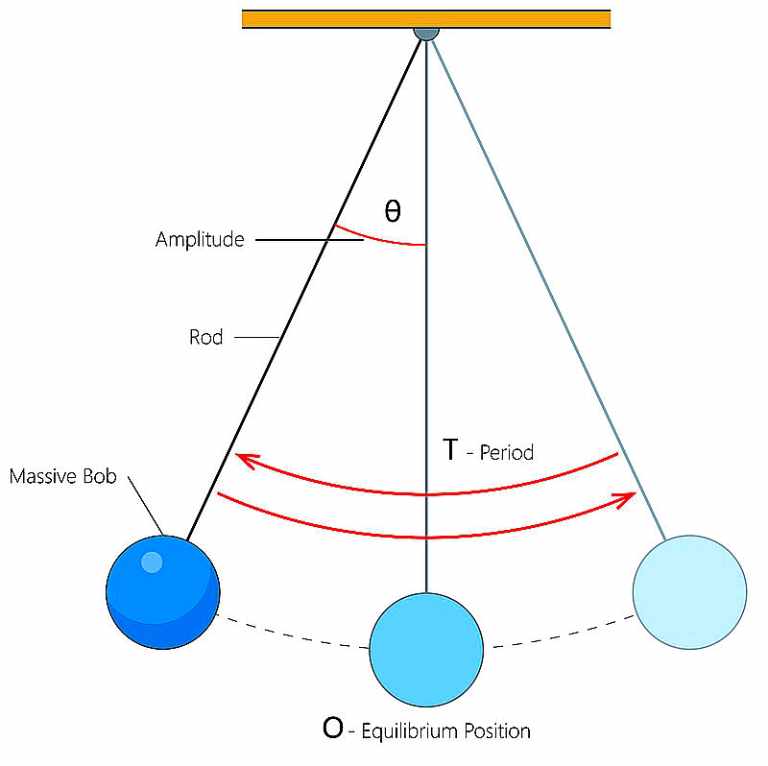
The following terms (features) are associated with a simple pendulum.
Oscillation (one complete swing): The bob moves from one extreme, to the other extreme, and back to the start (to and fro motion).
Period (T): This is the time for the pendulum to complete one full back-and-forth oscillation (one complete oscillation), in seconds.
Frequency (f): This is the number of complete oscillations the pendulum makes per second (measured in hertz (hz).
Amplitude: This is the maximum displacement from the rest position.
T = 1/f and f = 1/T
T = 2π√(L/g)
Where L is the length of the pendulum (from the point of suspension to the centre of the bob) and g is the acceleration due to gravity (about 9.8 m/s², or 10 m/s² in many exam questions).
For small angles, the period depends on length (L) and on acceleration due to gravity (g). It does not depend on the mass of the bob or on the amplitude. A longer pendulum has a longer period.
Please read the introduction to this topic (concept of time and ways of measuring time) here.
The period of a simple pendulum can be measured accurately in the laboratory by carryiny out the procedures below:
Set up the pendulum and give a small displacement (less than about 10°).
Start the stop watch as the bob passes the rest position (start counting at zero).
Time 20 or more complete oscillations.
Divide the total time by the number of oscillations to get the period -> T = total time / number of oscillations.
Repeat and take the average.
Note: Timing many oscillations reduces the effect of your reaction time in starting and stopping the watch.
Please read on fundamental, derived and supplementary quantities in physics here.
A Ticker-tape timer is a classic laboratory device used in physics to measure short time intervals, speed, and acceleration of moving objects
Below is the components and mechanism of action of a ticker-tape timer.
Vibrating Striker: An internal steel strip or needle vibrates rapidly up and down (usually at 50 Hz or 50 times per second) driven by an alternating current.
Carbon Paper: A paper tape passes under a carbon disc or paper as an object pulls it.
Marking Dots: Each vibration strikes the paper and leaves a small dot.
Time Interval: At a standard 50 Hz frequency, the time between any two consecutive dots is 1/50 s or 0.02 s
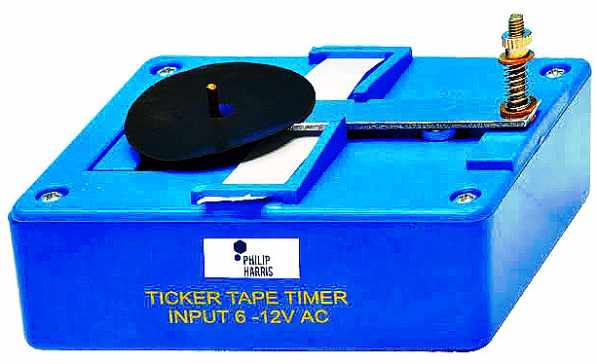
A ticker-tape timer has a vibrating arm driven by the alternating current (a.c.) mains, which makes a dot on a paper tape being pulled through it. In many countries the mains frequency is 50 Hz, so the timer makes 50 dots every second.
One tick (the space between two successive dots) = 0.02 s.
A ten-tick strip (ten spaces) = 10 × 0.02 = 0.2 s.
If dots are close together, the tape moved slowly. If they are far apart, the tape moved fast.
Please read on position, distance and displacement here.
Accuracy means how close a measurement is to the true value. Precision means how close repeated measurements are to each other.
Below are steps towards minimizing errors in timing.
Reaction Time: This is a delay of about 0.2 s in starting or stopping a stop watch by hand. This delay can be reduce it by timing a longer interval or many oscillations.
Zero Error: The timer does not start from zero. It can be corrected (or accounted for) by checking and correcting the timer before use.
Miscounting Oscillations: Always count carefully from a fixed reference mark.
Large Amplitude: The pendulum formula only works well for small angles.
Faulty Instrument: It can be caused by a clock that gains or loses time. It can be corrected by comparing against a reliable standard.
You can read on the basic and fundamental physics concepts here.
Example 1
Solution
60 seconds -> 1 minutes
60 minutes -> 1 hour
Therefore, 60 s × 60 s = 1 hour
3 hours = 3 × 60 s × 60 s = 10,800 s
Convert 20 minutes to seconds
Since there are 60 seconds in 1 minute, 20 seconds -> 20 × 60 = 1,200 s.
Example 2
Solution
Period (T) = Total Time / Number of Oscillations
T = 60 / 30 = 2 s
f = 1/T
f = 1/2 = 0.5 Hz
Please read on the concept of scalers and vectors here.
Example 3
Solution
T = Time period = 2 s
L = Length of the pendulum
g = Acceleration due to gravity ≈ 10 m/s2
T² = 4π²L/g
L = gT²/(4π²).
L = (10 × 2²)/(4 × 10)
L = 40/40 = 1 m
Note: A pendulum with a period of exactly 2 seconds is historically known as a seconds pendulum. This is so because it takes 1 second to swing in one direction and another 1 second to swing back, with each single swing (or "beat") corresponding exactly to one second of time.
Example 4
Solution
Step 1: Find the time per space (period): A ticker timer operating at a frequency (f) of 50 Hz makes 50 dots per second. The time interval (often called a "tick") between two consecutive dots, which forms one space, is given as 1/f
Step 2: Calculate the total duration: Since the tape has 25 spaces, multiply the number of spaces by the time per space.
Total time = 25 × 0.02 = 0.5 s.
Please read the next topic (motion in nature, definition, types causes, examples and effects) here.
Section A: Objective Questions
The SI unit of time is the _____. A. minute B. second C. hour D. hertz
Time is best described as _____. A. the distance between two points B. the speed of an event C. the duration between two events D. the direction of an event
Time is classified as a _____. A. derived vector quantity B. fundamental scalar quantity C. derived scalar quantity D. fundamental vector quantity
Which of the following is an old method of measuring time? A. Quartz watch B. Atomic clock C. Hour glass D. Digital stop watch
Which of the following is a modern method of measuring time? A. Sundial B. Water clock C. Candle clock D. Quartz clock
A sundial cannot be used to tell the time _____. A. in the morning A. at noon B. at night C. on a sunny day
Another name for the water clock is the _____. A. gnomon B. clepsydra C. chronometer D. oscillator
An atomic clock uses the vibrations of atoms of _____. A. hydrogen B. oxygen C. caesium-133 D. carbon
The time between two successive dots made by a ticker timer of frequency 50 Hz is _____. A. 0.2 s B. 0.05 s C. 0.02 s D. 0.5 s
The period of a simple pendulum does not depend on the _____. A. length of the string B. mass of the bob C. acceleration due to gravity D. place where it is used
To reduce the error in finding the period of a pendulum, a student should _____. A. use a very large amplitude B. time one oscillation only C. time many oscillations and divide by the number D. use a heavier bob only
A pendulum makes 50 oscillations in 100 s. Its frequency is _____. A. 0.5 Hz B. 2 Hz C. 5 Hz D. 50 Hz
How many seconds are there in 2 hours? A. 120 s B. 3,600 s C. 7,200 s D. 72,000 s
14. The unit “day” is based on the _____. A. revolution of the Moon around the Earth B. rotation of the Earth on its axis C. revolution of the Earth around the Sun D. swing of a pendulum
Which of these is the most accurate time-measuring device? A. Atomic clock B. Quartz watch C. Hour glass D. Mechanical watch
Section B: Theory Questions
(a) Define time. (b) State the SI unit of time and give its standard definition.
Explain the difference between an instant (time of day) and a time interval, with an example.
List four characteristics that a good timing device should have.
Name four periodic events that can be used to measure time.
Describe how each of the following works, and state one disadvantage of each: (a) sundial, (b) water clock, (c) hour glass.
Describe how a quartz watch works.
Why is the atomic clock regarded as the most accurate method of measuring time? State two uses of atomic clocks.
Distinguish between old and modern methods of measuring time using at least five points.
Describe an experiment to determine the period of a simple pendulum accurately. State two precautions.
Why is it better to time 20 oscillations than a single oscillation?
List three sources of error when timing an event with a stop watch.
What is a ticker-tape timer, and how can it be used to measure time intervals?
Section C: Calculation Questions
Take g = 10 m/s² and π² ≈ 10 unless told otherwise.
Convert 2.5 hours to seconds.
A pendulum makes 40 complete oscillations in 80 s. Calculate its (a) period, (b) frequency.
Calculate the length of a simple pendulum whose period is 2 s.
A pendulum bob has frequency 4 Hz. What is the time for 60 oscillations?
A student times 20 oscillations of a pendulum and records 36.4 s. Calculate the period.
A tape with 30 spaces is pulled through a ticker timer of frequency 50 Hz. How long did the pull take?
A quartz crystal vibrates 32,768 times each second. How long does it take to make 98,304 vibrations?
A caesium atom completes 4,596,315,885 periods of its radiation. How much time has passed? (1 s = 9,192,631,770 periods)
Express 1 ordinary year (365 days) in seconds, in standard form.
Two pendulums have lengths 1 m and 4 m. Find the ratio of their periods (T1 : T2).
Kindly share this article via the links below:
Please click here to contact Alfred if you require any of the following services:
If you need a standard website at an affordable price.
Online training on the academic subjects: biology, chemistry and basic science.
If you require an advanced smart school management system (web application) for your school.
Click here to read on Len Academy Smart School Software.
Please click here to follow Len Academy on Google News.
Amazing facts in Physics
Marie Curie was the first person ever to win two Nobel prizes. She won her first Nobel price for physics in 1903, and the second for chemistry in 1911 for her work on radioactivity.
The hottest temperature ever recorded occurred in Furnace Creek Ranch, Death Valley, California, USA, at 56.7oC or (134oF) on July 10, 1913

A medium-sized cumulus cloud has a weight of about 80 adult elephants.
You can think of cumulus cloud as a detached, individual, cauliflower-shaped cloud often seen in fair weather conditions

The reason the Leaning Tower of Pisa is tilted is the same reason it's still standing
One quarter of an apple is filled with air and that's why they float in water

The Nobel price was named after its founder, Alfred Noble. He is a Swedish, born on October 21, 1833; and was the inventor of dynamite. He was also a a famous scientist and a successful business man.

Glass balls bounce higher than rubber balls
Every planet has its own unique gravitational force. For instance, Mars has a gravity of 3.711 m/s2 while earth’s gravitational force is 9.807m/s2.
When two metals are put together in space, they will stick together as if they are welded. This phenomenon is called cold welding
The fastest animal on land is cheetah. It can reach a maximum speed of about 113km per hour.
Notable points in Physics
The Standard International (SI) unit for density is kilogram per cubic metre (Kg/m3).
The table below shows various substances with their densities:
|
Substance |
Density (Kg/m3) |
|
Helium |
0.179 |
|
Air (1atm and 20oC) |
1.20 |
|
Bamboo Wood |
400 |
|
Ethanol |
810 |
|
Methylated Spirit |
800 |
|
Benzene |
900 |
|
Paraffin Wax |
900 |
|
Ice |
920 |
|
Water (Fresh Water) |
1000 |
Force can be balanced or unbalanced.
When forces from different directions act on an object and consequently bring about the object's motion, then such forces are unbalanced.
Conversely, if theses forces bring about zero motion (static position or no movement) on the object of reference, then it's a balanced force.
In summary,
An apple hanging on a tree (without any form of movement) has a balanced force.
An apple falling from a tree has an unbalanced force.
If one covers a distance of 10,000 meters in 50 seconds and another covers the same distance in 5,000 seconds, we can conclude that the first person has a greater speed because he covered the same distance at a lesser time.
Speed is defined as distance travelled per unit of time. It can also be defined as the rate of change of distance.
Speed = distance/Time
Speed is a scalar quantity since it has only magnitude. Speed does not have a direction.
In physics, motion is defined as a change in the position of an object with reference to time.
Although we sometimes sit or stand in a fixed position, that doesn’t mean motion isn’t taking place. The fact that the earth is constantly rotating implies that we are indirectly moving along with it. We can thus say that motion can be relative to some frame of reference.
In the above paragraph, the earth (constantly rotating along its axis) is our frame of reference and everything present on earth is in motion (with regard to earth as a frame of reference).
Heat is a form of energy. It cannot be lost according to the first law of Thermodynamics; rather it will be transferred. The first and second laws of thermodynamics are stated below:
Energy can neither be created nor destroyed but can be transformed or converted from one form to another.
1st law of thermodynamics
In the course of energy transfer, some energy is lost in the form of heat to the surroundings.
2nd law of Thermodynamics